

SSL, TLS, and End-to-End Encryption: What Every Security Team Actually Needs to Know
The padlock in your browser means something—but probably not what most people think. This guide breaks down how transport encryption really works, where it silently fails, and what a correctly configured stack looks like in 2026.
Here’s a scenario that plays out thousands of times a day: a remote employee connects to your corporate VPN, opens their browser, sees the padlock icon, and assumes everything between their laptop and your servers is safe. Your security team might believe the same thing. Both assumptions can be dangerously incomplete.
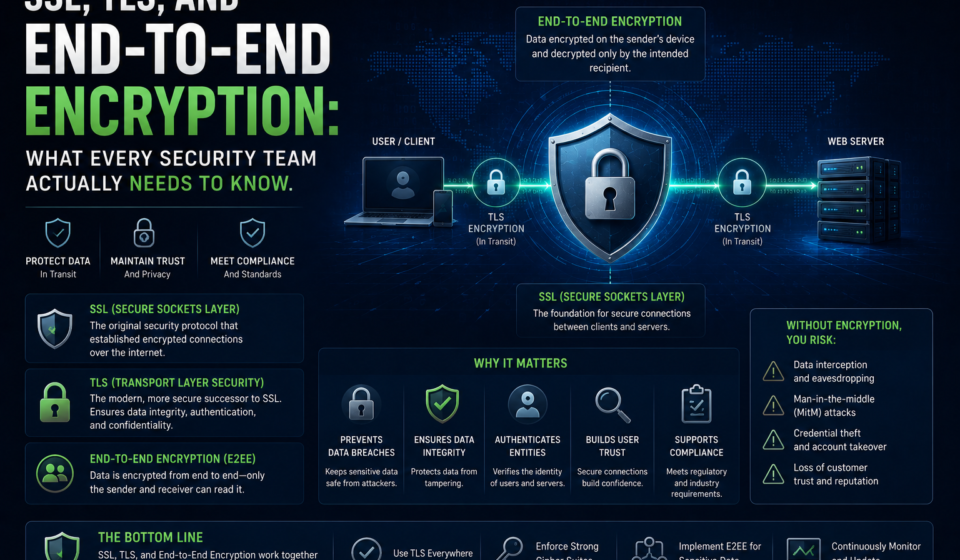
Transport-layer encryption—SSL, TLS, and their close relative, end-to-end encryption—is the backbone of secure communication on the internet. But “backbone” implies something solid and well-understood. In practice, these protocols are frequently misconfigured, poorly understood, and treated as a checkbox rather than a disciplined technical choice. The result: traffic that looks encrypted but is vulnerable to interception, downgrade attacks, or compromise at the endpoints the encryption never touches.
This guide covers how these protocols actually work, how they differ from each other, where each one breaks down in real deployments, and what a correctly hardened encryption stack looks like for an enterprise in 2026.
From SSL to TLS: A History of Necessary Deprecations
The common shorthand “SSL” survives in everyday speech and product branding long after the protocol itself was retired. Understanding why SSL died tells you a great deal about what TLS was designed to fix—and why even TLS has required ongoing revision.
Netscape developed SSL 1.0 internally in 1993 and never published it; SSL 2.0 shipped in 1995 with critical protocol flaws. SSL 3.0 arrived in 1996 and remained in widespread use for nearly two decades, despite accumulating a catalogue of known vulnerabilities. The final blow came in 2014 with POODLE (Padding Oracle On Downgraded Legacy Encryption), a practical attack against SSL 3.0 that could decrypt session cookies. The IETF formally deprecated SSL 3.0 in RFC 7568 in 2015.
TLS 1.0 launched in 1999 as a direct upgrade to SSL 3.0, introducing HMAC-based integrity checks and a more rigorous handshake. TLS 1.1 followed in 2006, primarily adding explicit initialization vectors to defend against CBC attacks. Neither version survived to 2020: the IETF deprecated both in RFC 8996, and major browsers dropped support the same year.
“Deprecation of outdated TLS versions is not bureaucratic hygiene—it is an operational acknowledgment that cipher suites age, attacks improve, and yesterday’s acceptable risk is today’s exploited vulnerability.” — NIST Special Publication 800-52 Rev. 2
The current recommended versions are TLS 1.2 (still acceptable with careful configuration) and TLS 1.3, which the IETF standardized in 2018. TLS 1.3 represents the most significant redesign of the protocol, removing decades of accumulated complexity and mandating properties—like forward secrecy—that were optional in earlier versions.
(Cloudflare Radar, 2024)
(Mozilla telemetry, Q4 2024)
(Verizon DBIR, 2024)
How TLS Actually Works
The Handshake
TLS operates in two phases: a handshake that establishes the session parameters and shared keys, and a record layer that encrypts the actual application data. Understanding the handshake is essential for diagnosing configuration problems and latency issues.
In TLS 1.2, the handshake requires two round trips (2-RTT) before encrypted application data can flow. The client advertises its supported cipher suites; the server selects one and sends its certificate; the client verifies the certificate, performs a key exchange, and both sides derive session keys from that exchange. Only then does application data begin.
TLS 1.3 reduces this to a single round trip (1-RTT). More significantly, TLS 1.3 supports 0-RTT resumption for returning sessions, allowing the client to send encrypted data in its very first message. This comes with a trade-off: 0-RTT data does not provide anti-replay protection and should be used only for idempotent requests.
Certificates and the CA Hierarchy
TLS authentication depends on X.509 certificates. A certificate binds a public key to an identity (typically a domain name) and is signed by a Certificate Authority (CA) that the client trusts. Your browser ships with a root store containing ~100–170 trusted root CAs; your operating system maintains a similar store. When a server presents a certificate, the client walks the chain of trust from that certificate back to a trusted root.
This architecture introduces a systemic risk: any trusted root CA can issue a certificate for any domain. Historically, several CAs have been compromised or acted maliciously. The Certificate Transparency (CT) framework, now mandatory for public CAs, addresses this by requiring all issued certificates to be logged in publicly auditable logs. Browsers enforce CT compliance; certificates issued without CT logging are rejected.
For enterprise environments managing internal services, deploying a private PKI (Public Key Infrastructure) with an internal root CA is a security best practice. This isolates internal certificate trust from the public CA ecosystem and allows granular control over certificate issuance, rotation, and revocation.
Forward Secrecy
Forward secrecy (or perfect forward secrecy, PFS) is a property of key exchange algorithms that ensures compromise of a server’s long-term private key cannot be used to decrypt previously recorded sessions. Without forward secrecy, an attacker who intercepts and records encrypted traffic—and later obtains the server’s private key—can retroactively decrypt everything they captured.
TLS 1.2 supports forward secrecy via ephemeral Diffie-Hellman (DHE) and elliptic-curve Diffie-Hellman (ECDHE) cipher suites, but these must be explicitly selected. Static RSA key exchange, which provides no forward secrecy, was still commonly deployed. TLS 1.3 resolves this by removing all non-forward-secret cipher suites. Every TLS 1.3 session uses ECDHE, making PFS mandatory rather than optional.
Organizations running network traffic inspection (TLS inspection/SSL decryption) break forward secrecy by design—the inspection appliance terminates the original TLS session and re-encrypts. This is a legitimate security pattern, but it must be architecturally explicit, with the inspection layer itself secured, logged, and audited. Undocumented TLS inspection is indistinguishable from a man-in-the-middle attack.
TLS Version Comparison
| Version | Status | Key Exchange | Forward Secrecy | Handshake RTT | Notable Vulnerabilities |
|---|---|---|---|---|---|
| SSL 3.0 | Deprecated (RFC 7568) | RSA, DH | No | 2-RTT | POODLE, BEAST |
| TLS 1.0 | Deprecated (RFC 8996) | RSA, DH, ECDH | Optional | 2-RTT | BEAST, POODLE (CBC) |
| TLS 1.1 | Deprecated (RFC 8996) | RSA, DH, ECDH | Optional | 2-RTT | POODLE (CBC) |
| TLS 1.2 | Acceptable (with hardening) | RSA, DHE, ECDHE | Optional (ECDHE) | 2-RTT | Lucky13, ROBOT (weak config) |
| TLS 1.3 | Recommended | ECDHE, DHE only | Mandatory | 1-RTT (0-RTT resumption) | 0-RTT replay (if misused) |
Cipher Suite Guidance for TLS 1.2
If your infrastructure must support TLS 1.2 for compatibility reasons, restrict the allowed cipher suites to ECDHE-based, AEAD-only options. NIST SP 800-52 Rev. 2 and the Mozilla TLS configuration guide both recommend the following:
# Recommended TLS 1.2 cipher suites (OpenSSL notation)
ECDHE-ECDSA-AES256-GCM-SHA384
ECDHE-RSA-AES256-GCM-SHA384
ECDHE-ECDSA-CHACHA20-POLY1305
ECDHE-RSA-CHACHA20-POLY1305
ECDHE-ECDSA-AES128-GCM-SHA256
ECDHE-RSA-AES128-GCM-SHA256

# Explicitly DISABLE
!RC4 !3DES !MD5 !EXPORT !NULL !aNULL !DSS !PSK !SRP
End-to-End Encryption: What HTTPS Doesn’t Cover
This is the most common and consequential misunderstanding in enterprise security: HTTPS is not end-to-end encryption.
TLS encrypts the connection between two endpoints—typically a client and a server. The server can read, store, log, and process everything it receives. If your threat model includes a compromised server, insider threat, or cloud provider with lawful access obligations, TLS alone provides no protection against any of these scenarios.
True end-to-end encryption (E2EE) means the content is encrypted at the sender’s device and decrypted only at the recipient’s device. The service provider routes ciphertext without ever having access to the plaintext. Practical E2EE systems include:
- Signal Protocol — used by Signal, WhatsApp, and others for messaging, providing E2EE with the double ratchet algorithm
- PGP/GPG — asymmetric email encryption; still the standard for high-security email workflows despite usability challenges
- Zero-knowledge storage — services like ProtonDrive or enterprise tools with client-side encryption where the provider holds only ciphertext
- Encrypted enterprise messaging — platforms that implement E2EE for internal communications, relevant for remote team security
Many products market themselves as “encrypted” while providing only TLS in transit and server-side encryption at rest. Server-side encryption at rest protects data from physical drive theft, not from the service provider, a breach of the provider’s systems, or a government order. Verify whether a product’s encryption is client-side (E2EE) or server-side before relying on it for sensitive data.
E2EE in Enterprise Contexts
E2EE introduces a genuine operational challenge: if the service provider cannot read content, neither can your IT or legal team, which complicates eDiscovery, compliance, and security monitoring. This is not a reason to avoid E2EE, but it is a reason to think carefully about which communications require E2EE and to implement appropriate key escrow or recovery mechanisms for business continuity.
For organizations navigating this balance, zero trust network architectures often separate the concerns: E2EE for content, while metadata and access patterns are logged and monitored through identity-aware infrastructure.
Where Enterprise TLS Deployments Break
Deployment failures cluster around a handful of recurring patterns. Security teams that audit for these specifically tend to find the majority of their exposure.
1. Mixed TLS Versions Across the Stack
A hardened public-facing load balancer running TLS 1.3 does nothing if internal service-to-service traffic falls back to TLS 1.0. Microservices architectures frequently inherit old TLS configurations from library defaults. Audit your entire network path, not just the ingress point. Internal east-west traffic between services often goes unaudited longest.
2. Certificate Expiry and Revocation Failures
Certificate expiry causes outages, but revocation failure is the less visible problem. OCSP (Online Certificate Status Protocol) relies on CA-operated responders that are sometimes slow, unreachable, or soft-fail by default in browsers (meaning an expired OCSP response is silently ignored). Certificate Transparency monitoring services can alert you to unexpected issuances against your domains, catching hijacking attempts earlier than most other mechanisms. Services like crt.sh provide free CT log monitoring.
3. TLS Inspection Without Policy Governance
SSL/TLS inspection appliances—next-gen firewalls, secure web gateways—are legitimate security tools when properly governed. They’re also frequently misconfigured: re-encrypting with outdated cipher suites, accepting any internal certificate including self-signed ones, or creating blind spots for encrypted malware C2 traffic. As detailed in TLS inspection best practices, inspection scope should be defined by policy, logged, and subject to the same cipher hardening as perimeter encryption.
4. Certificate Pinning Mismanagement
Certificate pinning, when implemented correctly, dramatically reduces the window for MITM attacks targeting your mobile clients. When implemented without a pin rotation strategy, it causes production outages during legitimate certificate renewals. Apps pinning leaf certificates (rather than public keys or intermediate CAs) break on every renewal cycle. The recommended approach is to pin the issuing CA’s public key and maintain a backup pin for the next rotation.
5. Weak Entropy and Key Generation
TLS security depends entirely on the cryptographic randomness used to generate keys and session nonces. Virtualized environments, particularly containers and VMs with low-entropy boot states, are a known risk. Deploy entropy augmentation (hardware RNG, virtio-rng for VMs) and validate CSPRNG availability before key generation operations.
Hardening Checklist: TLS Configuration
- Disable SSL 2.0, SSL 3.0, TLS 1.0, and TLS 1.1 on all endpoints
- Enable TLS 1.3 as the preferred version; TLS 1.2 as fallback only
- Configure TLS 1.2 to allow only ECDHE cipher suites with AEAD
- Verify TLS configuration on all load balancers, reverse proxies, and API gateways
- Audit internal service-to-service TLS (east-west traffic)
- Test with testssl.sh or Qualys SSL Labs for all public endpoints
- Implement automated certificate renewal (ACME/Let’s Encrypt or enterprise CA)
- Enable Certificate Transparency monitoring for all owned domains
- Configure HSTS with
includeSubDomainsandpreloaddirectives - Deploy HPKP alternative: CT log monitoring + CAA DNS records to restrict issuers
- Maintain a certificate inventory with expiry tracking and alerting at 60/30/7 days
- For mobile apps: implement public key pinning with rotation strategy
- Document all TLS inspection points; audit re-encryption cipher quality
- Validate entropy sources in virtualized/containerized environments
- Ensure private keys are stored in HSMs or secrets managers (not on disk)
- Define and test certificate revocation response procedures
- Review TLS configuration on third-party SaaS integrations for data in transit
- Run periodic re-assessment — TLS guidance evolves; quarterly review recommended
TLS in a Zero Trust Architecture
Zero trust reframes the security perimeter: rather than trusting everything inside the network and verifying at the edge, every request—regardless of origin—is authenticated, authorized, and encrypted. TLS is a foundational component of this model, but it requires extension beyond traditional configurations.
In a mature zero trust deployment, mutual TLS (mTLS) becomes the default for service-to-service communication. Standard TLS authenticates only the server; mTLS requires both parties to present certificates, enabling cryptographic verification of service identity rather than relying on network location or IP allowlists.
Implementing mTLS at Scale
Service meshes (Istio, Linkerd, Cilium) can enforce mTLS transparently across microservices, handling certificate issuance, rotation, and revocation through a control plane. This removes the burden of manual mTLS configuration from application developers while ensuring consistent enforcement. For organizations without service mesh infrastructure, a service proxy (Envoy) deployed as a sidecar provides similar benefits at lower architectural complexity.
Identity-Aware Proxies
Beyond mTLS, zero trust architectures commonly deploy identity-aware proxies that evaluate TLS sessions in combination with identity context—user identity, device posture, location, and risk signals. The encryption layer alone establishes authenticity of the connection; the identity layer establishes whether that connection should be trusted to access a given resource. For remote workforces, this combination replaces the traditional VPN model with per-resource authorization, reducing blast radius when credentials are compromised. See identity and access management for remote work for a deeper treatment.
Tools Worth Evaluating
These are tools commonly used by security teams for TLS management, testing, and enforcement. Selection should be driven by your specific deployment context.
Frequently Asked Questions
Build a More Defensible Infrastructure
GuardedWorker covers enterprise security for distributed teams—from zero trust architecture to secure remote access and identity management. If you found this guide useful, the security library covers adjacent topics in the same depth.
Browse the Security Library →

[…] SSL, TLS & End-to-End Encryption: The Complete Enterprise Guide […]
[…] must understand both physical safety standards and increasingly, data security protocols as harnesses become […]