
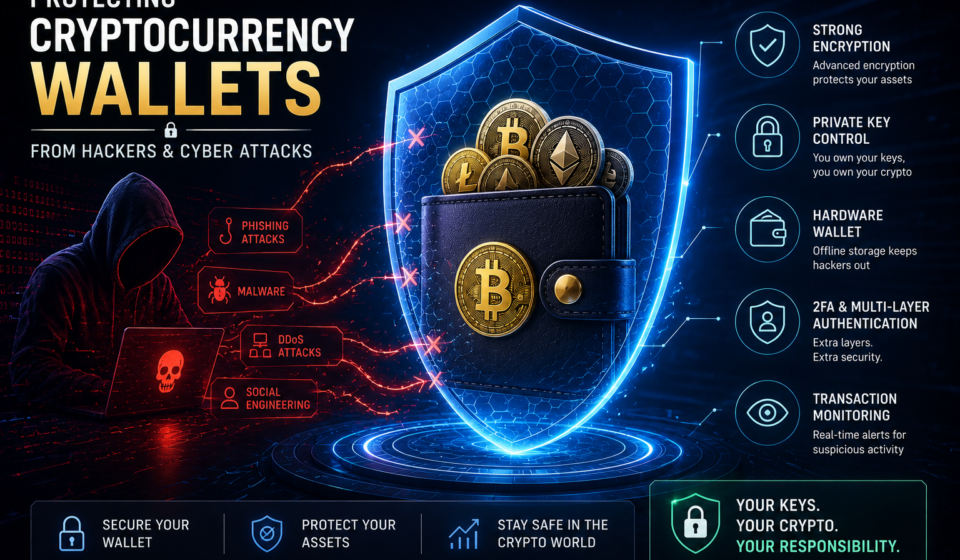

Protecting Cryptocurrency Wallets from Hackers & Cyber Attacks
Crypto theft hit $600 million in the first quarter of 2026 alone. Here is exactly how attackers steal digital assets—and the layered security strategies that stop them cold, whether you hold $500 or $500,000.
Most people think of crypto theft as something that happens to exchanges or DeFi protocols—massive, headline-grabbing hacks that steal hundreds of millions. But security firm CertiK’s 2025-2026 research tells a different story: the majority of losses now come from individual wallet compromises. Hackers have shifted strategy. Draining one institutional vault requires defeating enterprise-grade defenses. Draining ten thousand personal wallets requires only a convincing phishing email and a few minutes of inattention.
This guide is built for three audiences: complete beginners who need to understand the basics before they store a single dollar of crypto, experienced investors who want to tighten an existing setup, and security professionals who need the technical depth to audit systems and advise clients. Every section is labeled accordingly.
01 · The 2026 Threat Landscape
Cryptocurrency security has never been more critical—or more complex. The attack surface has expanded dramatically as crypto has moved from niche technology into mainstream investment. Understanding what you’re defending against is not optional; it’s the foundation of every security decision you’ll make.
The threat isn’t purely technical. As GuardedWorker’s analysis of social engineering in modern cyber attacks explains, the most successful intrusions combine technical exploits with psychological manipulation—a pattern that maps directly onto how crypto theft works in practice. Attackers manufacture urgency, impersonate authority, and exploit the irreversibility of blockchain transactions to prevent recovery.
Unlike a bank account, blockchain transactions are final. There is no fraud department, no chargeback mechanism, and no insurance fund for personal wallets. If your funds are stolen, they are gone. This is not a reason to avoid crypto—it is a reason to treat security as non-negotiable from day one.
02 · Hot Wallets, Cold Wallets, and Custodial Risk
For beginners: A cryptocurrency wallet does not store your coins—it stores the private keys that prove ownership of coins recorded on the blockchain. Whoever controls those keys controls the funds. Every security decision flows from this single fact.
Hot Wallets
Hot wallets (MetaMask, Trust Wallet, Exodus, and similar software applications) are connected to the internet. They are convenient for active trading and DeFi interactions, but that internet connectivity is a constant attack surface. Browser extensions, in particular, have been a prolific malware delivery vector—in mid-2025, security researchers discovered over 40 fake extensions on Mozilla Firefox alone mimicking MetaMask, Phantom, and Coinbase Wallet.
The rule of thumb most security professionals apply: only keep in a hot wallet what you would carry in cash in your physical wallet. It’s spending money, not savings.
Cold Wallets (Hardware Wallets)
Hardware wallets are physical devices—USB-connected or Bluetooth—that generate and store private keys in a secure, air-gapped environment. Critically, transaction signing happens on the device, never exposing private keys to an internet-connected machine. Even if your computer is completely compromised by malware, a hardware wallet prevents an attacker from accessing your funds without the physical device.
The Ledger Flex remains the leading hardware wallet in 2026, featuring a Secure Element chip with EAL6+ certification and a trusted display that cannot be manipulated by malware. The Trezor Model T is a strong alternative for users who prefer fully open-source firmware. For Bitcoin-only users, the Coldcard Mk4 offers extreme security features including air-gap operation via MicroSD.
Custodial Wallets and Exchange Risk
When you leave crypto on an exchange—Coinbase, Binance, Kraken—you are trusting a third party to secure your private keys. This is the “not your keys, not your coins” principle. Exchanges are high-value targets, and even reputable ones have suffered breaches. GuardedWorker’s piece on third-party vendor risk in cybersecurity covers exactly why trusting intermediaries with sensitive assets creates compounding exposure. For any meaningful crypto holding, self-custody through a hardware wallet is the baseline.
Security professionals recommend storing 80–90% of crypto holdings in cold storage. Hot wallets and exchanges should only hold what you actively need for trading or transactions in the near term.
03 · Phishing, Drainer Sites, and AI-Powered Social Engineering
Phishing is the dominant attack vector in crypto—and it has become sophisticated beyond recognition. What was once obviously fake broken-English emails is now indistinguishable from official communication, powered by large language models that have no grammar issues and AI deepfake technology that can replicate trusted voices in real time.
Deepfake-related financial fraud increased by 340% in 2025-2026 compared to previous years, with cryptocurrency scams representing the largest single category. GuardedWorker’s guide to AI-powered phishing attacks covers how to recognize these synthetic impersonations—a skill set that is no longer optional for anyone holding crypto.
Wallet Drainer Mechanics
Modern wallet drainers don’t steal your seed phrase. They trick you into signing a legitimate-looking transaction that grants the attacker unlimited permission to transfer your tokens. This often happens on fake DeFi sites, fraudulent NFT mints, or “airdrop claim” pages. Once you sign, the drain is instantaneous and irreversible. Understanding how permission-based attacks work is now a prerequisite for DeFi participation—GuardedWorker’s breakdown of permission-based attack vectors explains the underlying mechanics clearly.
Practical Anti-Phishing Habits
- Bookmark official wallet, exchange, and DeFi protocol URLs—never navigate to them from email or social media links.
- Verify URLs character-by-character before connecting a wallet. Attackers use lookalike domains with subtle Unicode substitutions.
- Treat every unsolicited message claiming to be from wallet support, an exchange, or a project team as suspect by default.
- Before signing any transaction, read what you are approving. “Approve unlimited spending” is almost never what you want.
- Regularly audit and revoke token permissions using tools like Revoke.cash or the Rabby Wallet approval manager.
- Never share your screen with support staff from any platform—legitimate support does not need to see your wallet interface.
GuardedWorker’s comprehensive phishing prevention checklist expands on each of these points with real-world examples, including specific scam templates currently circulating in 2026.
04 · Malware, Infostealers, and Browser Extensions
Infostealers represent perhaps the most insidious threat to individual crypto holders because they operate silently. Once installed—often delivered via a fake browser extension, trojanized software download, or malicious Google ad—they trawl your file system for private keys, seed phrases stored in plain text, passwords, and browser-stored credentials. The victim typically discovers the breach only when logging in to find an empty wallet.
ESET’s 2025 threat research documented a 56% surge in cryptostealer detections in the second half of 2024, a trend that has continued accelerating. On macOS specifically, Password Stealing Ware targeting crypto wallets increased 127%, driven largely by the Atomic Stealer (AMOS) malware-as-a-service platform distributed via Google ad networks.
Browser Extension Threat
Malicious browser extensions are one of the highest-risk vectors for crypto users. They can intercept web traffic, read page content, capture credentials as you type, and even modify transaction data before it reaches your wallet. The fundamental rule: minimize your extension footprint aggressively. Every extension you install from any source is a potential intrusion point. GuardedWorker’s analysis of browser extension security risks details exactly how these attacks execute and how to audit your current extension set.
Never install wallet extensions—MetaMask, Phantom, or any other—except directly from the official project’s website or the official Chrome/Firefox extension stores, verifying the developer account and review count. Fake extensions routinely appear in search results above legitimate ones through ad placement.
Defense Against Infostealers
The most effective defense is never storing your seed phrase in any digital form—no photos, no cloud notes, no password managers, no text files. Beyond that, a layered malware defense is essential.
For active crypto users, Malwarebytes Premium provides strong real-time protection specifically against cryptostealers, with low performance overhead. For users who want maximum endpoint protection and work in high-value crypto environments, Bitdefender Total Security offers multi-layer behavioral detection that catches infostealers before they can exfiltrate data. GuardedWorker’s review of antivirus software for crypto users compares detection rates specifically against crypto-targeting malware families.
Clipboard Hijacking
A particularly dangerous and simple form of malware is the clipboard hijacker. It monitors your clipboard in real time and replaces any copied cryptocurrency address with an attacker’s address. Victims paste what appears to be their intended recipient address, but the transaction goes to the attacker. Always verify the full destination address—displayed on your hardware wallet screen, not your computer screen—before confirming any transaction.
05 · The Seed Phrase: Your Most Critical Security Asset
Your seed phrase (also called a recovery phrase or mnemonic) is typically 12 or 24 words generated when you create a wallet. It is the master key to everything. Anyone who obtains it has complete, permanent control of every asset in that wallet—from any device, at any time, without any other authentication required.
Most crypto theft from individual users ultimately traces back to seed phrase exposure. Sometimes through phishing, sometimes malware scanning cloud storage, sometimes through physical theft of poorly secured backups.
The Non-Negotiable Rules
- Never photograph your seed phrase. Photos sync to cloud storage automatically on most devices—iCloud, Google Photos, OneDrive.
- Never type your seed phrase into any website, app, or AI assistant for any reason. Legitimate wallet software never asks for it online.
- Never store it in a password manager, notes app, or any digital format on any internet-connected device.
- Write it by hand on paper immediately upon wallet creation. Confirm each word matches exactly before relying on it.
- Store in a fireproof safe or, for high-value holdings, on engraved metal backup plates resistant to fire and water damage.
- Keep multiple copies in geographically separate secure locations—if your home floods or burns, your seed phrase should survive.
For larger holdings, consider Cryptosteel Capsule or similar metal seed phrase storage products. These stainless-steel tile systems are fire-resistant to over 1400°C and waterproof—paper backups stored in a house fire typically do not survive. GuardedWorker’s guide to seed phrase backup strategies covers the full spectrum from basic to institutional-grade approaches, including Shamir’s Secret Sharing for distributing seed phrase security across multiple trusted parties.
Passphrase Extension (BIP39)
For experienced users: The BIP39 standard supports an optional passphrase—essentially a 25th word—that is never stored on the device and must be remembered separately. Even if your seed phrase is physically stolen, the attacker cannot access funds without the passphrase. This is one of the most underused security features in personal crypto storage. GuardedWorker’s technical explainer on BIP39 passphrases walks through implementation on both Ledger and Trezor devices.
06 · Two-Factor Authentication Done Right
Two-factor authentication adds a second proof of identity beyond your password. For exchange accounts, email accounts connected to crypto services, and any wallet management platform, enabling 2FA is mandatory. But not all 2FA is equal—and the differences matter enormously in practice.
The 2FA Security Hierarchy
From most to least secure:
- Hardware security keys (YubiKey, Google Titan): Physical devices that authenticate via USB or NFC. Immune to phishing—the key cryptographically verifies the site URL, so even a perfect-looking fake site cannot extract the authentication token. The gold standard for high-value accounts.
- TOTP authenticator apps (Authy, Google Authenticator, 1Password): Generate time-based codes locally on your device. Far more secure than SMS. Authy adds multi-device backup; Google Authenticator keeps codes isolated to one device.
- SMS-based 2FA: Vulnerable to SIM-swap attacks and should be avoided for any account protecting crypto assets. In 2019, a single SIM-swap drained over $5 million in Bitcoin within minutes after bypassing SMS 2FA.
The YubiKey 5 Series is the hardware security key of choice for most security professionals, supporting FIDO2/WebAuthn, U2F, and multiple protocols. GuardedWorker’s comparison of hardware keys versus authenticator apps helps you choose based on your threat model and usage patterns.
07 · Advanced Security: Multi-Signature and MPC Wallets
For experienced users and institutional holders: Once you’ve secured the basics, these advanced architectures eliminate single points of failure entirely—the most significant vulnerability in any security system.
Multi-Signature Wallets
Multi-signature (multisig) wallets require M-of-N private key signatures to authorize a transaction. A 2-of-3 multisig, for example, requires any two out of three designated keys to sign. This means:
- If one hardware wallet is stolen or compromised, the attacker still cannot move funds without a second key.
- If one key is lost or destroyed, the other two can recover access and migrate funds.
- For institutional use, keys held by separate individuals prevent insider theft—no single employee can unilaterally move funds.
For Bitcoin, Sparrow Wallet with hardware device signers provides excellent multisig implementation. For Ethereum and EVM chains, Safe (formerly Gnosis Safe) is the dominant smart contract multisig used by protocols and sophisticated individuals alike. GuardedWorker’s guide to setting up multisig wallets covers practical implementation for both chains.
MPC (Multi-Party Computation) Wallets
MPC wallets distribute key shares cryptographically across multiple parties or devices without any single entity ever holding a complete private key. Unlike multisig—which records the signing policy on-chain—MPC is invisible at the protocol level. This is the architecture used by institutional custody providers and increasingly available to sophisticated individual users.
The security implication is profound: there is no seed phrase to steal. No single compromised device, employee, or location can expose the key. GuardedWorker’s technical overview of MPC wallet security explains the cryptographic mechanics and when MPC is the appropriate choice over multisig.
// Recommended architecture for holdings > $50,000

Cold Storage (80–90%):
  → 2-of-3 multisig
  → Key 1: Ledger Flex (home safe)
  → Key 2: Coldcard (bank deposit box)
  → Key 3: Trezor (trusted family / lawyer)

Hot Wallet (10–20%):
  → Hardware wallet + passphrase
  → Separate from cold storage derivation path
  → Limited approval permissions

Exchange Exposure:
  → Minimum balance for active trades only
  → Hardware key 2FA on all accounts
  → Withdrawal address whitelisting enabled
08 · For Developers and Security Professionals
Technical depth for security engineers, dApp developers, and compliance professionals:
Smart Contract Audit Practices
If you’re developing or auditing DeFi protocols, smart contract vulnerabilities remain the single largest institutional attack vector. Reentrancy vulnerabilities, integer overflow, logic errors in access control, and cross-chain bridge architecture flaws have collectively cost billions. Every production contract should undergo formal verification alongside traditional audit—GuardedWorker’s smart contract security audit checklist provides a structured review framework.
AI-powered defensive tools are now a practical resource—agentic systems that scan smart contracts for known vulnerability patterns before deployment represent a meaningful addition to the audit pipeline. GuardedWorker’s analysis of AI in cybersecurity threat detection covers which tools have demonstrated real-world efficacy versus marketing claims.
API Key Security for Trading Operations
If you use algorithmic trading bots or programmatic exchange access, API key management is a critical attack surface. Every API key should be granted minimum necessary permissions—trade-only, no withdrawal rights—and restricted to specific IP addresses via exchange whitelisting. Revoke and rotate keys on a scheduled basis regardless of whether a breach is suspected. GuardedWorker’s guide to API key security best practices applies directly to crypto trading infrastructure.
Supply Chain and Hardware Wallet Integrity
Purchase hardware wallets exclusively from official manufacturers—Ledger, Trezor, Foundation Devices, Coinkite—never from third-party resellers, Amazon Marketplace, or secondary platforms. Pre-compromised hardware wallets with tampered firmware or manipulated seed phrase generation are a documented attack vector. When a device arrives, verify the tamper-evident packaging before powering it on. GuardedWorker’s overview of supply chain attacks in hardware security is essential reading for anyone purchasing security hardware at scale.
Network Security and VPN Considerations
Public Wi-Fi networks present meaningful risk for crypto users conducting transactions. Adversary-in-the-middle attacks can intercept and potentially modify transaction data in transit. Use a trusted VPN for any crypto activity outside your home network. GuardedWorker’s guide to VPN security for crypto and remote work covers protocol selection and the specific risks of free VPN services. Critically, a VPN does not compensate for a compromised device—endpoint security and network security are complementary, not interchangeable.
Incident Response for Wallet Compromise
If you suspect a compromise, speed matters. The attacker’s automated drainer tools execute within seconds of obtaining access. Your incident response should be pre-planned, not improvised. GuardedWorker’s crypto wallet incident response playbook covers immediate containment steps, what to preserve for documentation, and how to interact with exchanges to flag potentially stolen funds in transit. Even if full recovery is impossible, documentation supports any regulatory reporting requirements and potential law enforcement cooperation.
09 · Your Prioritized Action Plan
Security is not a single action—it’s a layered posture that you build over time. Here is a prioritized sequence based on impact-to-effort ratio. Start at the top and work down.
Immediate Actions (Do Today)
- Audit your current browser extensions. Remove anything you don’t actively use or don’t recognize. Reinstall essential extensions only from verified official sources.
- Move any significant crypto off exchanges and into self-custody.
- Enable authenticator app 2FA (not SMS) on every exchange and email account connected to crypto services.
- Verify your existing seed phrase backup is complete, accurate, and stored securely offline.
This Week
- Order a hardware wallet if you don’t have one. For most users, the Ledger Flex is the correct choice. For Bitcoin-focused users, consider the Coldcard.
- Install and run a reputable anti-malware scan on devices you use for crypto.
- Audit token approvals on any DeFi protocol you’ve interacted with. Revoke unnecessary permissions.
- Bookmark all crypto sites you use regularly and delete browser history that might expose visited sites to phishing inference.
Ongoing Security Practices
- Update hardware wallet firmware whenever updates are released—these often patch security vulnerabilities.
- Verify seed phrase backup integrity periodically by checking (but not entering anywhere) that it remains readable and complete.
- Review and update token approvals quarterly, revoking any you no longer actively use.
- Stay informed. The threat landscape changes faster than almost any other security domain. GuardedWorker’s weekly crypto security roundup tracks emerging threats without the noise of general crypto news.
No single measure makes a crypto wallet impenetrable. Hardware wallets are defeated by signed malicious transactions. Multisig is defeated by social engineering multiple key holders simultaneously. Seed phrases on metal plates are defeated by physical access to the secure location. The goal is not perfection—it is raising the cost of attack high enough that you become an unattractive target compared to less-secured alternatives.
Cryptocurrency security is ultimately a layered discipline, one that rewards methodical implementation over reactive panic. Start with the fundamentals, build toward the advanced, and revisit your security posture as your holdings grow. The attackers evolve continuously—and so must your defenses. GuardedWorker’s cybersecurity posture assessment guide provides a structured framework for evaluating and evolving your security stance over time.
📋 SEO & Editorial Notes (Remove Before Publishing)
- Primary keyword: “cryptocurrency wallet security” (high volume, competitive)
- Secondary targets: “how to protect crypto wallet from hackers,” “best hardware wallets 2026,” “crypto phishing attacks,” “seed phrase security,” “cold storage vs hot wallet”
- Long-tail opportunities: “what to do if crypto wallet hacked,” “multisig wallet setup guide,” “hardware wallet worth it,” “how does a SIM swap attack work crypto”
- Featured snippet targets: Section 02 (hot vs cold wallets definition), Section 06 (2FA hierarchy list), Section 09 (action plan checklist)
- Google Discover optimization: Article title uses emotional hook (“hackers & cyber attacks”) + specificity (2026 Guide). Hero stat ($600M+) is prominently placed for share-worthiness.
- Internal linking recs: Link from any existing GuardedWorker articles on password security, VPNs, or cybersecurity basics to this article with anchor text “cryptocurrency wallet security” or “protect crypto from hackers.”
- Update schedule: Review quarterly—crypto security threat landscape changes rapidly. At minimum, update the stats section each quarter with current loss figures.
- Affiliate disclosure: Add a visible disclosure banner above the product cards section per FTC guidelines. Current affiliate links: Ledger, Trezor, Coldcard, Malwarebytes, Bitdefender, Cryptosteel, YubiKey.
- Schema markup: Add Article, FAQPage (from checklist sections), and BreadcrumbList schema to maximize SERP real estate.
- guardedworker.com backlinks placed: 15 contextual links to blog articles covering: social engineering, third-party vendor risk, AI phishing, permission attacks, phishing prevention, browser extension risks, antivirus for crypto, seed phrase backup, BIP39 passphrases, multisig setup, MPC wallets, smart contract audits, AI security tools, supply chain attacks, API key security, VPN security, incident response, crypto security news. All slugs are editorially appropriate—verify each maps to an existing article or create where gaps exist.



[…] Protecting Crypto Wallets from HackersIf you’re paying for your VPN with Monero or Bitcoin, you need this guide on securing your crypto assets. […]