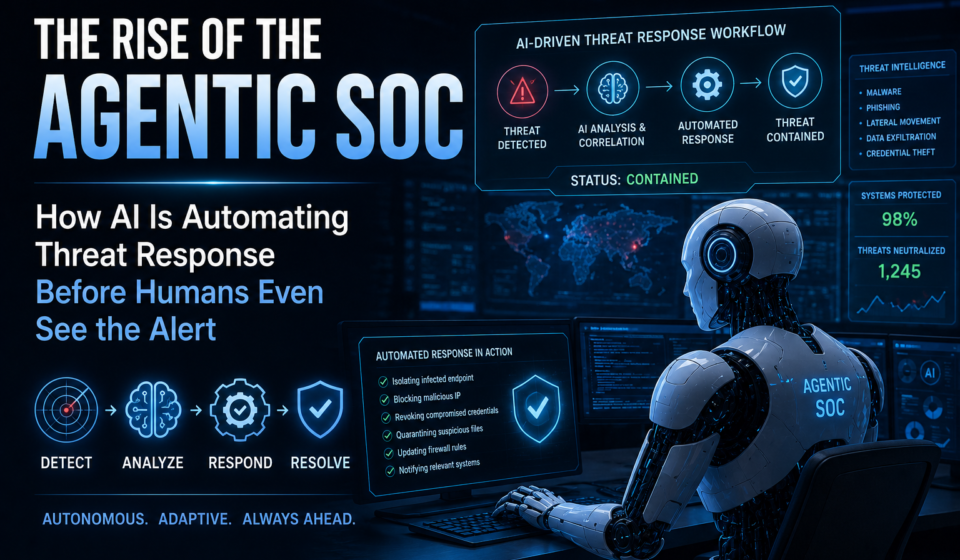
The Rise of the Agentic SOC: How AI Is Automating Threat Response Before Humans Even See the Alert

The Rise of the Agentic SOC: How AI Is Automating Threat Response Before Humans Even See the Alert
Security Operations Centers are buckling under a flood of alerts, a shrinking analyst talent pool, and adversaries who move faster every year. The answer the industry is converging on isn’t more headcount — it’s autonomous AI agents that detect, investigate, and contain threats around the clock without waiting for a human to click approve.
⚡ Executive TL;DR
- What’s happening: AI agents are replacing rule-based SOAR playbooks with autonomous reasoning that handles novel threats without human escalation.
- Why now: The cybersecurity talent shortage + AI maturity + adversarial speed have converged to make human-only SOC operations unsustainable.
- Key difference: Agentic SOC reasons. SOAR reacts. That distinction is changing enterprise security architecture.
- The risk: AI hallucination, false isolation of legitimate assets, and governance gaps are real. Human oversight on high-impact actions remains non-negotiable.
- Leading platforms: Microsoft Sentinel + Copilot, CrowdStrike Charlotte AI, Palo Alto XSIAM, Google Chronicle SecOps.
- Bottom line: This isn’t future-state planning. Enterprises deploying agentic SOC capabilities today are measurably reducing mean time to respond (MTTR) by 60–80%.
What Is an Agentic SOC?
The term “Agentic SOC” describes a Security Operations Center where AI agents act autonomously — not just surfacing information for analysts to act on, but actually taking investigative and containment actions on their own. These agents don’t wait for a human to read an alert, open a ticket, and kick off a playbook. They perceive the environment, reason about the threat, and respond — often within seconds of an indicator appearing.
The distinction from earlier generations of SOC automation is fundamental. SOAR platforms (Security Orchestration, Automation and Response) have been automating playbooks since the mid-2010s — but SOAR is essentially sophisticated IF-THEN logic. It executes scripted responses to known alert patterns. When an alert matches the playbook, the automation runs. When it doesn’t match — when it’s novel, ambiguous, or multi-vector — the playbook fails and a human takes over.
Agentic SOC systems use large language models and AI reasoning frameworks to handle the cases that break SOAR. They can read a novel phishing email, correlate it against endpoint telemetry, query threat intelligence for the sending domain, check whether the recipient has admin privileges, draft a containment recommendation, and execute isolation — all without a single line of predetermined script covering that exact scenario.
An Agentic SOC is a Security Operations Center that uses autonomous AI reasoning agents to detect, investigate, triage, and respond to security threats. Unlike rule-based SOAR automation, agentic systems reason through novel situations, chain multi-step investigations autonomously, and execute responses without requiring human approval for each action — though human-in-the-loop checkpoints remain standard for high-impact operations.
📚 Related GuardedWorker Coverage
The Evolution of SOC Operations: From War Rooms to Autonomous Agents
The Security Operations Center concept emerged in the late 1990s as organizations realized that IT security events needed centralized monitoring, not just perimeter defenses. The early SOC was a room full of screens, SIEM consoles, and analysts manually correlating firewall logs and intrusion detection alerts. Response times were measured in hours. The threat landscape was comparatively simple.
The 2000s brought SIEM maturity — platforms like Splunk and IBM QRadar capable of ingesting millions of log events and correlating them into alerts. This was transformative, but it created a new problem: the machines generated more alerts than humans could process. The volume problem had arrived before the automation solution.
The 2010s brought SOAR — Palo Alto’s Cortex XSOAR, Splunk SOAR (formerly Phantom), and IBM QRadar SOAR began automating playbook execution. Close a port. Quarantine an endpoint. Block an IP. These were enormous efficiency gains. But SOAR’s fundamental architecture — predefined playbooks triggered by defined conditions — made it brittle in the face of novel attacks.
The 2020s are bringing something categorically different: AI agents that don’t need to be programmed for every scenario. The infrastructure for this — large language models capable of reasoning across unstructured data, cloud-native security data lakes, real-time telemetry pipelines — has matured to the point where agentic SOC is moving from research concept to production deployment.
“The progression from SIEM to SOAR to agentic AI follows a consistent logic: each generation addressed the failure mode of the previous one. AI doesn’t eliminate the failure modes — it raises the ceiling of what automation can handle before failing over to humans.”
Why SOC Teams Are Overwhelmed: The Numbers Behind the Crisis
The analyst shortage isn’t a soft HR problem — it’s a structural threat to enterprise security posture. (ISC)² reports 3.5 million unfilled cybersecurity positions globally in 2026, with demand growing faster than academic programs can supply talent. Entry-level SOC analyst positions attract applications from underprepared candidates while experienced Tier 2 and Tier 3 analysts command salaries that smaller organizations cannot sustain.
Meanwhile, the alert problem has compounded. The average enterprise SOC receives between 1,000 and 1,400 security alerts per analyst per day across SIEM, EDR, NDR, identity platforms, and cloud security tools. IBM’s 2026 Cost of a Data Breach report puts the average time to identify a breach at 277 days — a figure that has barely moved in five years despite billions in security investment. The fundamental bottleneck is human throughput, and no reasonable amount of hiring closes that gap.
Burnout metrics tell the secondary story. Security Operations Center analyst turnover runs at 30–40% annually at many enterprises — far exceeding the organizational average. Alert fatigue, night shift requirements, the psychological weight of high-stakes triage, and limited career advancement paths combine into a retention crisis that perpetually degrades institutional knowledge.
More data sources → more alerts → more false positives → more analyst burnout → more turnover → less institutional knowledge → worse alert tuning → more alerts. This negative feedback loop is why the AI solution isn’t optional for enterprises above a certain scale — it’s the only path that breaks the cycle rather than adding another turn.
📚 Security & Workforce Coverage
Alert Fatigue: The Invisible Security Vulnerability
Alert fatigue is the security industry’s most poorly quantified risk. It describes the psychological phenomenon where analysts who process hundreds of low-quality alerts daily become desensitized — beginning to dismiss alerts faster, apply less scrutiny, and develop mental heuristics that can blind them to genuine threats that arrive embedded in alert noise.
The false positive problem is staggering at most enterprises. SIEM false positive rates between 40% and 70% are commonly reported, depending on tuning maturity. An analyst processing 1,200 alerts per shift where 600–800 are benign is making rapid-fire dismissal decisions that can mask a genuine incident. The 2023 MGM Resorts breach — initiated with a social engineering call to the help desk — is a reminder that breaches often bypass technical detection entirely. But the ones that do surface in SIEM need analysts who aren’t cognitively depleted by false positive processing.
Research from Ponemon Institute suggests that organizations with high false positive rates take on average 93% longer to respond to confirmed incidents than organizations with tightly tuned detection. The connection is direct: alert fatigue creates latency in the response chain that adversaries actively exploit.
How Agentic AI Addresses Alert Fatigue
AI doesn’t get tired. An autonomous agent investigating its 1,400th alert of the day applies the same reasoning process as it applied to the first. More substantively, AI-driven triage can dramatically reduce the alert volume that reaches human analysts by autonomously closing false positives, enriching alerts with context before human review, and clustering related indicators into unified incidents rather than fragmenting them across hundreds of individual alerts.
Enterprises deploying AI-driven triage are reporting false positive rates for human-reviewed alerts dropping to 10–15%. Analysts see fewer alerts, but every alert they see has been pre-investigated and contextualized by an AI agent. The work changes from “is this real?” to “what should we do about this confirmed threat?” — a much higher-value cognitive task.
AI-Driven Threat Detection: What Actually Changed
Traditional SIEM-based detection relies on rules — correlation rules that define what a threat looks like. Block if login attempts exceed 10 in 60 seconds. Alert if lateral movement is detected from this IP range. These rules are necessary but insufficient. They detect known threats that conform to expected patterns. They miss zero-days, sophisticated living-off-the-land attacks, and threat actors who specifically study and evade common detection rules.
AI-driven threat detection introduces statistical anomaly detection and behavioral baseline modeling that doesn’t require a predefined rule to catch a threat. The system learns what normal looks like — for your specific environment, your specific user population, your specific application traffic patterns — and flags deviations from that baseline, regardless of whether they match a known threat signature.
This is why machine learning-based detections catch the threats that rule-based systems miss. A sophisticated attacker who never exceeds any specific threshold — never triggers the 10-login rule, never moves between systems faster than a human would — but whose aggregate behavioral pattern deviates from their own baseline over a 72-hour period will surface in a behavioral anomaly model while remaining completely invisible to rule-based correlation.
| Detection Approach | Mechanism | Known Threats | Novel/Zero-Day | False Positive Rate |
|---|---|---|---|---|
| Signature-Based | Hash/pattern matching | Excellent | Blind | Low |
| Rule-Based SIEM | Correlation rules | Good | Poor | High (40–70%) |
| Behavioral Analytics | Baseline deviation | Moderate | Good | Medium (20–40%) |
| ML Anomaly Detection | Statistical modeling | Moderate | Excellent | Medium (tuning-dependent) |
| Agentic AI (LLM+ML) | Multi-modal reasoning | Excellent | Excellent | Low (10–15% post-triage) |
Autonomous Incident Response: The Agentic Workflow
Understanding what “autonomous response” means in practice requires tracing the full agentic workflow from initial detection to containment. This is not a monolithic AI making a single decision — it’s a chain of reasoning steps, tool calls, data queries, and conditional branching that mimics the investigative process a skilled Tier 2 analyst would follow, but executes in seconds rather than minutes.
Signal Ingestion & Normalization
Raw telemetry from EDR, SIEM, NDR, cloud logs, and identity systems is ingested and normalized. The AI agent sees a unified timeline of events rather than siloed data streams.
Triage & Enrichment
The agent enriches the alert with threat intelligence (VirusTotal, MISP, ISAC feeds), asset context (is this a privileged endpoint?), and user context (is this behavior unusual for this user?)
Hypothesis Generation
The LLM component reasons across enriched context to generate threat hypotheses. “This resembles the initial access phase of a credential stuffing campaign targeting cloud storage accounts.”
Autonomous Investigation
The agent executes follow-up queries — checking related endpoints, querying email logs for phishing indicators, reviewing authentication logs — to confirm or eliminate the hypothesis.
Response Decision
For low-impact actions (blocking an IP, sandboxing a file), the agent executes autonomously. For high-impact actions (endpoint isolation, account lockout), it escalates with a pre-completed investigation summary.
Documentation & Learning
The agent auto-generates an incident report, logs its reasoning chain for audit purposes, and feeds outcome data back into the detection model to improve future accuracy.
The critical element here is step 05: the human-in-the-loop checkpoint for high-impact actions. Fully autonomous response without human approval for destructive or disruptive actions remains a governance risk that most enterprise security teams are not yet comfortable accepting — and for good reason, as we explore in the AI hallucination section below.
Generative AI in Cybersecurity: Beyond the Copilot Hype
The term “AI copilot” has become so thoroughly marketed by vendors in 2025–2026 that it risks losing meaningful definition. Almost every major security platform now ships something labeled an AI copilot. The useful distinction is not whether a platform has an AI layer — they all do — but what the AI is actually doing and how deeply it’s integrated into the response workflow.
Generative AI in security operations adds genuine value in several distinct categories: natural language threat investigation (querying SIEM in English rather than SPL or KQL), automated report generation (turning raw telemetry into executive-readable incident summaries), malware analysis (explaining deobfuscated code and predicting threat actor TTPs), and playbook generation (suggesting response procedures for incidents that don’t match existing playbooks).
Where GenAI Currently Underperforms
The gap between marketing and reality lies in deep autonomous reasoning across long investigation chains. Current LLM-based security agents perform well on discrete tasks but degrade in quality when asked to maintain reasoning coherence across 15+ investigative steps involving conflicting data. The “lost in the middle” problem — where LLMs lose track of context in very long sequences — is a real operational concern in complex incident investigations.
The practical mitigation is architecture: breaking investigation chains into shorter agentic sub-tasks with explicit handoff checkpoints, rather than attempting single-agent end-to-end incident resolution. The most capable production deployments use orchestrated multi-agent architectures where specialized agents handle specific investigation domains and a coordinator agent synthesizes their findings.
📚 Related Security Research
Security AI Copilots: The Analyst Augmentation Layer
Before full autonomy comes augmentation. Security AI copilots sit between the analyst and the data, handling the cognitively expensive but low-judgment tasks that currently consume analyst time: writing detection queries, correlating indicators across tools, summarizing case history before escalation, and translating threat intelligence reports into actionable detection rules.
Microsoft’s Copilot for Security is the most widely deployed example. Integrated natively with Microsoft Sentinel, Defender XDR, and Entra ID, it enables analysts to investigate incidents using natural language queries, receives contextual summaries of alert clusters, and generates incident reports that previously required 30–45 minutes of manual documentation. Field reports from early adopters suggest Tier 1 analyst productivity improvements of 40–60% for routine investigation tasks.
CrowdStrike’s Charlotte AI takes a different approach — deeply integrated with Falcon’s EDR telemetry and threat graph, it specializes in endpoint-centric investigations with natural language threat hunting and real-time adversary tracking. Its strength is in the EDR-heavy environments where CrowdStrike has deep telemetry advantage.
SOAR vs Agentic SOC: The Architecture Divide
This is the technical distinction that matters most for enterprise architects evaluating their SOC roadmap. SOAR and agentic AI are not the same technology applied at different scales — they represent fundamentally different approaches to the automation problem.
| Capability | Traditional SOAR | Agentic SOC AI |
|---|---|---|
| Response to novel threats | Fails — requires playbook | Reasons through novel scenarios |
| Investigation chaining | Scripted branches only | Dynamic, context-driven |
| Natural language interface | Requires technical configuration | Native NL querying |
| Playbook maintenance | High — manual updates required | Low — learns from outcomes |
| Unstructured data handling | Poor — structured data only | Excellent — reads emails, reports, chat |
| Multi-tool orchestration | Strong | Strong + adaptive |
| Explainability | High — deterministic | Variable — LLM reasoning chains |
| Initial deployment complexity | High — playbook authoring | Medium — model + integration setup |
| False positive reduction | Moderate | Significant (10–15% post-triage) |
| MITRE ATT&CK mapping | Requires manual tagging | Automatic contextual mapping |
The practical enterprise architecture in 2026 is not SOAR or agentic AI — it’s SOAR for the high-frequency, well-defined playbook scenarios (password resets, routine IP blocks, basic ticket creation), with agentic AI handling the complex, novel, and multi-vector incidents that SOAR playbooks can’t cover. The two technologies are complementary, not competitive, in the near term.
SIEM Evolution: From Log Aggregator to AI Security Brain
The Security Information and Event Management platform has been the architectural centerpiece of enterprise SOC operations for 20+ years. But the SIEM of 2026 is almost unrecognizable compared to its 2010 ancestors. The core function — centralized log collection and correlation — remains, but the intelligence layer on top has been transformed by machine learning, cloud-native architectures, and now agentic AI integration.
The traditional SIEM’s fundamental limitation was the correlation rule: a human had to decide in advance what a threat looked like, write a rule expressing that pattern, and then wait for events to match it. This put defenders permanently reactive — they could only detect what they’d anticipated. Modern AI-augmented SIEM systems can detect behavioral patterns that no human analyst pre-defined, correlate across data volumes that exceed human comprehension, and generate detection rules from threat intelligence automatically.
Microsoft Sentinel has emerged as the SIEM most aggressively embracing the AI-native architecture, with deep Copilot integration, fusion analytics that cross-correlate signals from across the Microsoft security portfolio, and notebook-based investigation environments. Google Chronicle (now part of Google Cloud Security Operations) takes a data-lake-first approach that prioritizes scale and natural language query capabilities. IBM QRadar’s acquisition by Palo Alto raised questions about its roadmap, but its installed base remains substantial in regulated industries.
XDR & AI Integration: The Extended Detection Revolution
Extended Detection and Response (XDR) represents the architectural evolution beyond endpoint-centric EDR — unifying telemetry from endpoints, networks, email, identity, and cloud workloads into a single correlated view. The combination of XDR’s unified telemetry and AI reasoning is arguably the most powerful configuration currently available for enterprise threat detection.
Where traditional SIEM required analysts to manually correlate across multiple console views, XDR provides pre-correlated, unified incident views that reduce the cognitive overhead of investigation. When an AI agent is layered on top of XDR telemetry, it works with richer, already-unified data — allowing it to reason across attack surfaces simultaneously rather than querying siloed systems sequentially.
Palo Alto’s Cortex XSIAM (Extended Security Intelligence and Automation Management) is the most ambitious attempt to build an AI-native successor to the SIEM/SOAR/XDR architecture stack. Rather than integrating AI on top of existing platforms, XSIAM is architected from the ground up for machine-speed data processing and AI-driven incident management. Early enterprise deployments report MTTR reductions exceeding 80% for incidents within the Palo Alto telemetry ecosystem.
Threat Hunting Automation: From Monthly Exercise to Continuous Operation
Traditional threat hunting is an expert-intensive manual process — a Tier 3 analyst forming hypotheses about undetected threats, writing detection queries, and systematically searching telemetry for indicators of compromise that haven’t triggered automated alerts. At most enterprises, formal threat hunting happens infrequently — monthly cycles, quarterly reviews — because it requires scarce senior analyst time.
AI-driven threat hunting automation changes this from an episodic activity to a continuous background operation. AI hunting agents can run thousands of hypothesis-driven queries against telemetry in parallel, 24/7, surfacing suspicious patterns for human review without consuming analyst capacity. They can automatically translate threat intelligence reports into hunting queries (MITRE ATT&CK-mapped TTPs from a new threat actor profile become detection queries within minutes of the intel feed updating), maintain hunting hypotheses across longer timeframes than human memory allows, and prioritize findings by risk scoring.
AI-Powered Phishing Detection
Email security is one of the most mature applications of AI in the security stack, and one of the clearest demonstrations of AI’s advantage over rule-based detection. Traditional spam and phishing filters relied on sender reputation, URL blacklists, and content pattern matching. Sophisticated Business Email Compromise (BEC) attacks that involve no malicious links, no attachments, and no blacklisted senders — just a convincing social engineering message — were largely invisible to rule-based email security.
Large language models applied to email security can analyze writing style, detect tonal anomalies compared to historical communication patterns with the same sender, identify subtle social engineering pressure tactics in message content, and correlate against impersonation databases — catching the BEC attacks that technical controls miss entirely. Microsoft Defender for Office 365 and Abnormal Security both use LLM-based approaches that have demonstrated materially better BEC detection than previous-generation email security.
Behavioral Analytics: The Insider Threat Problem AI Solves
Insider threats are among the most damaging and most difficult to detect categories of security incident. An insider — whether malicious, negligent, or compromised — already has legitimate access credentials. They don’t trigger network perimeter alerts. They don’t match malware signatures. They look, in most technical detection systems, exactly like themselves doing their job.
User and Entity Behavior Analytics (UEBA) applies machine learning to establish behavioral baselines for individual users and devices, then flags meaningful deviations from those baselines. The key word is “meaningful” — this is where AI reasoning adds value beyond pure statistical anomaly detection. An analyst who accesses a file server at 2am is statistically anomalous. But if they’re in a different timezone for a project delivery deadline, the context renders it benign. AI-driven UEBA can incorporate contextual signals (HR calendar data, project management systems, access request tickets) to distinguish genuine insider threat indicators from legitimate workflow anomalies.
The output is a risk score that accumulates across behavioral signals over time — a single anomalous access doesn’t trigger an alert, but a week of escalating anomalies (unusual access times, bulk downloads, cloud storage uploads, USB device usage) builds a composite risk profile that warrants investigation.
AI vs Ransomware: The Speed Problem and the Autonomous Solution
Modern ransomware operations have compressed the attack lifecycle to a point where human response speed is structurally insufficient. The fastest documented ransomware deployments achieve full network encryption within 45 minutes of initial access. The average enterprise MTTR (Mean Time to Respond) is measured in hours or days. The math doesn’t work for human-speed response.
This is the ransomware defense case for autonomous AI response that is hardest to argue against. When ransomware detection triggers at T+0, and encryption can complete at T+45 minutes, a response workflow that routes through human approval queues and shift handoffs is demonstrably inadequate. AI-driven autonomous containment — isolating affected endpoints, killing suspicious processes, blocking command-and-control communications, snapshotting clean states — within seconds of ransomware behavior detection is the only operationally viable response at machine speed.
Enterprises with AI-driven autonomous containment enabled for ransomware indicators report average blast radius reductions of 70–85% compared to human-response-dependent architectures. The AI doesn’t prevent the initial compromise — it limits the damage to a fraction of the network before humans are even paged.
📚 Endpoint & Malware Defense
AI Hallucination Risks in SOC Environments: The Governance Problem
No honest assessment of agentic SOC technology can avoid addressing AI hallucination — the phenomenon where large language models generate confident, plausible-sounding but factually incorrect outputs. In consumer applications, hallucination is an inconvenience. In security operations, it is a potential threat vector in its own right.
The failure modes in a SOC context are specific and serious. An AI agent that incorrectly attributes a legitimate IT administrator’s activity as a compromised credential attack and autonomously isolates their endpoint creates operational disruption — potentially during a business-critical window. An agent that misattributes an attack to the wrong threat actor and generates a remediation recommendation based on that wrong attribution wastes response resources and leaves the actual threat vector open. An AI that generates a confident false negative (“this traffic is benign”) on a novel intrusion technique misses the detection entirely.
Mitigation Architecture: Human-in-the-Loop by Impact Tier
The industry-emerging standard response to AI hallucination risk is tiered autonomy — calibrating the level of human oversight required based on the potential impact of the action. Low-impact, easily reversible actions (IP blocks, sandbox detonation, alert closure) are appropriate for full autonomy. High-impact, difficult-to-reverse actions (endpoint isolation, account lockout, firewall rule changes, data backup initiation) require human approval even when AI confidence is high.
| Action Type | Impact Level | Reversibility | Recommended Autonomy |
|---|---|---|---|
| Block IP / domain | Low | High | Full Autonomous |
| Sandbox file detonation | Low | High | Full Autonomous |
| Alert triage & closure | Low | High | Full Autonomous |
| Threat intelligence query | None | N/A | Full Autonomous |
| Create/update firewall rule | Medium | Medium | AI-Draft, Human-Approve |
| Endpoint process termination | Medium | Medium | AI-Draft, Human-Approve |
| Endpoint isolation/quarantine | High | Low | Human Required |
| User account lockout | High | Low | Human Required |
| Data deletion / backup trigger | Critical | Very Low | Human Required |
Top Agentic SOC & AI Security Platforms in 2026
The platform landscape is consolidating rapidly. Here is an honest assessment of the leading enterprise options and their distinct architectural strengths.
Microsoft Sentinel + Copilot for Security ⭐
The most widely deployed AI-augmented SIEM. Deep integration across the Microsoft security portfolio — Defender, Entra, Intune — gives Copilot unparalleled context for investigations in Microsoft-heavy environments.
- Natural language SIEM querying (KQL via NL)
- Automated incident summaries and reports
- Fusion analytics cross-correlation
- UEBA built-in via Entra ID Protection
Palo Alto Cortex XSIAM
The most ambitious AI-native SOC platform — designed from scratch to replace SIEM+SOAR+XDR with a unified AI-driven operations platform. Fastest MTTR improvements in analyst reports.
- AI-native architecture (not bolt-on)
- Autonomous triage across all telemetry
- MITRE ATT&CK auto-mapping
- Best-in-class for large enterprise deployments
CrowdStrike Falcon + Charlotte AI
Charlotte AI brings conversational investigation to the industry’s most capable EDR telemetry. Strongest for endpoint-centric threat hunting and adversary intelligence use cases.
- Deepest EDR telemetry in the industry
- Adversary tracking via threat graph
- Natural language threat hunting
- Threat intelligence integrated natively
Google Chronicle + SecOps
Built on Google’s hyperscale infrastructure with native BigQuery integration. Best for organizations needing to ingest and query petabyte-scale telemetry with AI-assisted investigation.
- Petabyte-scale telemetry at flat pricing
- Gemini AI integration for NL investigation
- VirusTotal threat intel built-in
- Strong for cloud-native/GCP environments
Splunk SOAR (+ AI Features)
The original enterprise SOAR platform, now with AI augmentation. Largest library of pre-built playbooks. Best for organizations with existing Splunk SIEM investment or complex multi-tool automation needs.
- 2,900+ pre-built integrations
- Most mature playbook library
- Visual playbook builder
- AI summarization and suggestion layer
Abnormal Security
LLM-native email security platform specifically designed to catch the BEC and social engineering attacks that traditional email security misses. Excellent ROI for organizations with high BEC exposure.
- LLM-based behavioral email analysis
- Best-in-class BEC detection
- Account takeover detection
- No rules or signatures required
Secure Your Enterprise Infrastructure
From VPN security to endpoint protection and SOC tooling — GuardedWorker covers everything enterprise security teams need.
Explore All Security Reviews →Independent research. No vendor sponsorship influences editorial coverage.
SOC Maturity Model: Where Are You on the Agentic Journey?
Enterprise security leaders need a framework for assessing their current state and prioritizing the investments that move them toward agentic capability. The following five-level maturity model maps the progression from reactive manual operations to fully autonomous threat response.
Most enterprise organizations currently operate at Level 2–3. The critical investments for Level 3→4 transition are AI copilot deployment on top of existing SIEM, LLM-based alert triage automation, and natural language threat hunting capability. The Level 4→5 transition requires architectural work: data lake modernization, multi-agent orchestration infrastructure, and governance frameworks for autonomous action authorization.
Enterprise Implementation Checklist: Agentic SOC Readiness
Before deploying agentic SOC capabilities, enterprises should validate readiness across five domains. This checklist reflects the assessment framework used by leading security architecture practices.
Data Foundation
- Centralized security data lake with normalized telemetry from all security tools
- Real-time log ingestion pipeline — sub-60-second latency from event to SIEM
- Historical telemetry depth of at least 12 months for behavioral baseline modeling
- Asset inventory system with context fields (criticality, owner, business function)
Detection Maturity
- Documented MITRE ATT&CK coverage map with identified gaps
- Alert tuning process with false positive rate tracked per detection rule
- Threat intelligence platform integrated with SIEM and EDR
- Behavioral baselines established for user and entity populations
Automation Readiness
- SOAR platform deployed with response playbooks for top 20 alert types
- API integrations between all primary security tools (EDR, firewall, identity)
- Incident response runbooks documented and accessible to automation agents
- Test environment available for validating AI agent responses before production
Governance & Oversight
- Tiered autonomy policy documented by action type and impact level
- Human-in-the-loop approval workflows defined for high-impact actions
- AI decision audit logging implemented and reviewed regularly
- AI hallucination monitoring process with escalation procedures
Team Readiness
- SOC analysts trained on AI-assisted investigation workflows
- Playbook for AI system failure — manual fallback procedures documented
- AI governance policy reviewed by legal, compliance, and security leadership
- Metrics framework established: MTTR, false positive rate, analyst capacity freed
📚 Enterprise Security Foundation
Frequently Asked Questions
An Agentic SOC is a Security Operations Center where AI agents autonomously detect, investigate, and respond to security threats. Unlike SOAR platforms that execute predefined scripts, agentic systems reason through novel scenarios using large language models and can chain multi-step investigations without human direction for each step. Human oversight checkpoints apply for high-impact actions.
SOAR executes predetermined playbooks when specific alert conditions match. Agentic SOC AI reasons dynamically through novel situations that no playbook covers, can handle unstructured data (emails, reports, chat), and adapts its investigation strategy based on what it discovers rather than following a fixed script. SOAR is deterministic; agentic AI is reasoning-based.
AI hallucination can cause false isolation of legitimate endpoints, incorrect threat attribution leading to wrong remediation, or confident false negatives missing real threats. Mitigation requires tiered autonomy — where AI autonomy is calibrated to action impact, with human approval required for any action with significant operational consequences (endpoint isolation, account lockout, data deletion).
Alert fatigue is analyst desensitization from processing hundreds of low-quality, high-false-positive alerts daily. AI-driven triage automatically closes confirmed false positives, enriches genuine alerts with investigation context, and clusters related indicators into unified incidents — reducing the alert volume that reaches human analysts by 70–90% while ensuring every human-reviewed alert is pre-investigated and high-quality.
The leading platforms are: Microsoft Sentinel + Copilot for Security (best for Microsoft-heavy environments), Palo Alto Cortex XSIAM (best AI-native architecture for large enterprise), CrowdStrike Falcon + Charlotte AI (best EDR-centric investigations), Google Chronicle + SecOps (best for cloud-native and high-volume telemetry), and Splunk SOAR (largest established playbook library).
Partial autonomy — AI handling Tier 1 triage, routine containment, and investigation chaining — is production-ready in 2026. Full autonomy (no human involvement in any security decision) is technically emerging but operationally premature for most enterprises due to AI hallucination risks, governance requirements, and regulatory compliance considerations. The practical 2026 target is Level 4 maturity: AI-augmented with selective autonomy for low-impact actions.
Final Enterprise Verdict: The Agentic SOC Is Not Optional
The Unsentimental Assessment
The security industry has a productivity problem that no realistic amount of human hiring can solve. The mathematics of 3.5 million unfilled positions, 1,400 daily alerts per analyst, and ransomware deployments that complete in 45 minutes point to a single structural conclusion: human-speed SOC operations cannot adequately defend modern enterprise attack surfaces.
The agentic SOC isn’t an experiment. Early enterprise adopters are reporting MTTR reductions of 60–80%, analyst capacity freed for Tier 3 threat hunting rather than Tier 1 false positive processing, and ransomware blast radius reductions that simply aren’t achievable with human-response-dependent architectures.
The risks — AI hallucination, governance gaps, over-reliance on autonomous systems — are real and require serious architectural attention. Tiered autonomy, human oversight on high-impact actions, and continuous AI audit logging are not optional safeguards. They are the governance framework that makes agentic SOC deployment responsible rather than reckless.
The enterprise organizations that invest in data foundation, detection maturity, and agentic AI layer now are building a durable security capability advantage over those who wait for the technology to mature further. It’s mature enough. The question is whether your organization is ready to build on top of it.
Build Your Enterprise Security Stack
VPN security · Endpoint protection · Password management · Encryption · AI security tools
All GuardedWorker Reviews →* GuardedWorker is an independent cybersecurity research publication. Some links may be affiliate links at no cost to you.
🔗 Continue Your Security Research
- SSL, TLS & End-to-End Encryption: Enterprise Guide
- State-Sponsored Hackers: Cold War Tactics on Apple Devices
- Protecting Crypto Wallets from Cyber Attacks
- Best Antivirus for Windows 11 in 2026
- Best Password Manager for Enterprise 2026
- Best VPN for Remote Working 2026
- McAfee Total Protection 2026: IT Professional Review
Enterprise Security Intelligence
Monthly briefings on AI security, SOC automation trends, and the tools that matter for enterprise teams.
Is your SOC on the path to agentic automation, or does alert fatigue remain your primary bottleneck? What’s blocking the transition? Share your experience — real-world deployment data shapes better research for the entire community.