
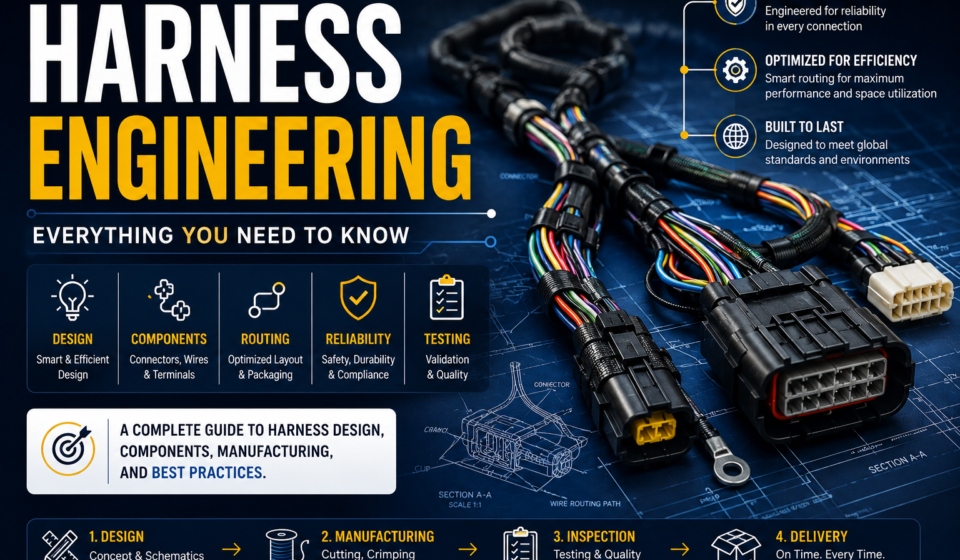

Harness Engineering:
Everything You Need to Know
The discipline that connects every machine on earth — from Tesla Cybertrucks to Boeing airframes — and the career nobody talks about enough.
What You’ll Learn in This Guide
- Harness engineering = designing the organized bundles of wires and connectors that power modern machines.
- Used in automotive, aerospace, medical devices, industrial automation, and more.
- Salaries range from $65K–$120K+ depending on industry and experience.
- Key tools include Zuken E3.series, Mentor Capital, and AutoCAD Electrical.
- AI and automation are actively reshaping harness design and manufacturing in 2026.
- Engineers must understand both physical safety standards and increasingly, data security protocols as harnesses become “smart.”
What Is Harness Engineering? (The Definition That Actually Makes Sense)
Harness engineering is the discipline of designing, specifying, manufacturing, and testing wire harnesses — structured bundles of electrical wires, cables, and connectors that carry power and data signals through vehicles, aircraft, industrial machines, and electronic systems. Also called wiring harness engineering or cable harness engineering.
Think about what’s inside your car door. Not the handle or the glass — the invisible nervous system behind it. There are wires for the window motor, speaker, side mirror actuator, heated seat element, door sensor, and ambient lighting. Every one of those wires has to go somewhere. Someone designed exactly how they’d be organized, protected, routed, and connected. That person is a harness engineer.
Now scale that up. A modern commercial aircraft contains over 300 miles of wire. An electric vehicle like the Rivian R1T has a wiring harness that weighs over 60 kilograms. An industrial robot arm needs harnesses that can survive 10 million flex cycles without a single break.
Harness engineering sits at the intersection of electrical engineering, mechanical design, manufacturing, and quality assurance. It’s one of the most technically demanding specializations in modern industry — and one of the most underrepresented in engineering conversations.
How Wire Harnesses Work: The Core Concepts
A wire harness is more than a bundle of wires with tape around it. It’s a precisely engineered system with multiple interconnected components, each chosen for specific electrical, mechanical, and environmental reasons.
The Anatomy of a Wire Harness
| Component | Function | Common Materials |
|---|---|---|
| Conductors (Wires) | Carry electrical current or data signals | Copper, tinned copper, aluminum |
| Insulation | Prevent short circuits; resist heat, chemicals | PVC, XLPE, PTFE, silicone |
| Connectors | Mate with mating connectors on devices/PCBs | Nylon, PBT, brass contacts |
| Terminals | Crimp onto wire ends; create electrical contact | Brass, copper, tin-plated |
| Protective Coverings | Shield from abrasion, moisture, heat, vibration | Braided sleeving, conduit, heat-shrink, tape |
| Strain Relief | Prevent wire movement from stressing connections | Grommets, cable clamps, zip ties |
| Junction Splices | Branch signals to multiple destinations | Solder sleeves, crimp splices |
The Signal Types Harnesses Carry
Harnesses don’t just carry power. In modern systems they transport:
- High-voltage power — EV battery cables, industrial motor drives (up to 800V+)
- Low-voltage control signals — sensor outputs, switch inputs, actuator control
- Data protocols — CAN bus, LIN bus, Ethernet (100BASE-T1 in automotive), ARINC 429 (aerospace), Modbus (industrial)
- RF signals — antenna feeds, radar connections
- Fiber optic — high-speed data in aerospace and luxury automotive
“A wire harness is essentially the nervous system of any complex machine. Get it wrong and the machine fails. Get it right and it’s invisible forever.”— Common adage among veteran harness engineers
Where Harness Engineers Work: Industries & Applications
Wire harness engineering isn’t confined to one sector. It’s everywhere machines need electricity and communications. Here are the major industries and what makes each unique:
| Industry | Key Application | Special Challenge | Avg. Salary Premium |
|---|---|---|---|
| Automotive (ICE) | Body, powertrain, infotainment harnesses | High volume, extreme cost pressure | Baseline |
| EV / EV Trucks | High-voltage battery, charging, e-axle | HV safety, thermal management | +12–18% |
| Aerospace | Avionics, flight controls, nacelles | DO-160G, weight minimization, reliability | +20–30% |
| Defense | Vehicle electronics, weapons systems, comms | MIL-SPEC compliance, harsh environments | +25–35% |
| Medical Devices | MRI machines, surgical robots, monitors | Biocompatibility, FDA validation, ultra-reliability | +15–22% |
| Industrial Automation | Robot arms, CNC machines, conveyors | Continuous flex, EMI shielding | +8–14% |
| Renewable Energy | Wind turbine nacelles, solar inverters | UV resistance, extreme weather | +5–12% |
🔗 Security Matters in Industrial Engineering Too
- How Agentic AI Is Changing the Malware Landscape in 2026 Modern harness design software and industrial IoT systems are prime targets. Learn what the threat landscape looks like for engineering organizations.
- Securing Public-Facing APIs from Unauthenticated Exploitation Many smart harness testing platforms expose APIs. Here’s how to keep them locked down.
The Harness Engineering Design Process (Step by Step)
Professional harness engineers don’t just “draw wires.” There’s a rigorous, structured process from concept through validation. Here’s what that process actually looks like in 2026:
Phase 1: Requirements Capture
Before a single wire is sized, the engineer needs to understand the system. This includes:
- Functional requirements — what signals must travel where?
- Environmental conditions — temperature range, vibration profile, fluid exposure, UV, EMI
- Regulatory standards — ISO 6722 (automotive wire), DO-160G (aerospace), IPC/WHMA-A-620 (workmanship), SAE J1128/J1939
- Packaging constraints — available routing paths, bend radii, mounting points
- Weight budget — critical in aerospace and EV applications
Phase 2: Schematic Design
The electrical schematic defines every connection in the system. Harness engineers use schematic capture tools to document circuit topology before any physical design begins. This is where wire gauges, voltage ratings, and connector families are first specified.
Phase 3: Physical Layout (Formboard / 3D Routing)
The harness is then laid out — either on a 2D formboard drawing (for manufacturing) or as a 3D routed geometry within the vehicle/aircraft CAD model. This is where engineers solve:
- Routing paths that avoid heat sources, sharp edges, and moving parts
- Minimum bend radius compliance for every wire gauge
- Separation between high-voltage and data cables (EMI management)
- Backshell angle and connector face orientation
- Harness fixation and support clamp placement
Phase 4: Bill of Materials Generation
From the design tools, a complete BOM is generated listing every wire (with its cut length, gauge, color code), every connector, every terminal, every piece of protective material. This feeds directly into procurement and manufacturing.
Phase 5: Prototype & Testing
A prototype harness is built from the formboard or 3D data. Testing includes:
- Continuity testing — every circuit checked end-to-end
- Hi-pot (dielectric) testing — voltage withstand verification
- Mechanical testing — pull force on terminals, connector mating/unmating cycles
- Environmental testing — thermal cycling, fluid immersion, vibration, salt spray
- EMC testing — radiated emissions and susceptibility
Phase 6: Manufacturing Release & Production Support
The final engineer deliverable is a complete manufacturing package: formboard drawings, wiring diagrams, assembly instructions, test procedures, and inspection criteria. During production ramp, harness engineers support process issues, engineering changes, and supplier qualifications.
Essential Harness Engineering Software & Tools in 2026
The right software stack is what separates a productive harness team from one buried in spreadsheets and manual errors. Here’s the current state of the art:
| Software | Best For | Price Tier | AI Features (2026) |
|---|---|---|---|
| Zuken E3.series | Enterprise automotive/industrial harness design | Enterprise | Auto-routing suggestions, DRC |
| Mentor Graphics Capital | Automotive OEM full-vehicle electrical | Enterprise | Variant management, AI optimization |
| Siemens Xpedition | Defense, aerospace, complex mixed harness/PCB | Enterprise | Integrated PLM, AI weight optimizer |
| CATIA Electrical | Aerospace (Airbus, Boeing use cases) | Enterprise | 3D routing with MBSE integration |
| AutoCAD Electrical | Smaller teams, industrial panels, general schematics | Mid-range | Symbol libraries, basic automation |
| Harness-X | Independent manufacturers, low-volume, custom | Accessible | Cloud-based, growing AI feature set |
| SolidWorks Routing | Mechanical engineers adding wire routing to 3D | Mid-range | Integrated with SolidWorks PDM |
Physical Tools for Harness Manufacturing & Testing
Molex SL/Micro-Fit Hand Crimper
The go-to for engineers prototyping harnesses with Molex connectors. Produces consistent, reliable crimps that meet IPC/WHMA-A-620 Class 3 requirements.
❌ Cons: Specific to connector family; expensive for multiple families
CableEye M3U USB Harness Tester
Automated continuity and hi-pot tester for harness QA. Used by small-to-medium manufacturers for production line verification.
❌ Cons: Limited to lower-complexity harnesses; no 4-wire Kelvin measurement
Fluke 117 Electrician’s Multimeter
The trusted field tool for harness troubleshooting. Non-contact voltage detection, resistance, continuity with audible beep — essential kit for any harness engineer.
❌ Cons: No data logging; need Fluke 87V for advanced diagnostics
Salisbury HV Rubber Gloves (Class 00)
Mandatory PPE when working on EV high-voltage harnesses. ASTM D120 rated. The difference between going home and not going home.
❌ Cons: Must be re-tested every 6 months per OSHA requirements
Schleuniger WireStripper 9550
Semi-automatic wire stripping machine for prototype to low-volume production. Handles 24 AWG to 4 AWG. Consistent strip lengths every time.
❌ Cons: High upfront cost; overkill for one-off prototyping
Panduit Wire Marking Labels
Professional wire identification labels that survive automotive, marine, and industrial environments. Heat-resistant, chemical-resistant, laser-printable.
❌ Cons: Requires compatible printer; premium cost vs generic labels
Key Standards and Certifications Harness Engineers Must Know
Harness engineering is one of the most standards-heavy disciplines in electrical engineering. Here are the critical ones:
🏆 Must-Know Industry Standards
- IPC/WHMA-A-620 — The global standard for wire harness workmanship. “Class 3” is the aerospace/military tier requiring the highest quality.
- SAE J1128 — Specifications for low-voltage primary wire used in road vehicles.
- USCAR-2 / USCAR-21 — Connector and crimped wire terminal performance requirements. Required by most North American automakers.
- DO-160G — Environmental test conditions for airborne equipment. Covers temperature, vibration, humidity, and EMI for aerospace harnesses.
- MIL-DTL-38999 — Circular connector standard for military and aerospace applications.
- ISO 6722 — Road vehicles — 60V and 600V single-core cables: dimensions, test methods.
- IEC 62196 — EV charging connector standards; relevant for on-board EV harness engineers.
- UL 508A — Industrial control panel wiring standards used in factory automation.
Relevant Professional Certifications
While no single “harness engineer” certification exists, these credentials are widely recognized:
- IPC/WHMA CIS (Certified IPC Specialist) — Validates knowledge of IPC/WHMA-A-620 workmanship standards. Highly valued by harness manufacturers and aerospace primes.
- IPC/WHMA CIT (Certified IPC Trainer) — For experienced engineers who train manufacturing teams.
- BICSI RCDD — Relevant for data center and structured cabling harness work.
- Professional Engineer (PE) License — Important for engineers signing off on safety-critical designs.
- Six Sigma (Green/Black Belt) — Valuable for harness engineers working in high-volume automotive manufacturing environments.
Harness Engineering Careers: Salaries, Roles, and Growth Paths
The harness engineering career path is more varied — and better compensated — than most people realize. Here’s the full picture:
| Role | Experience | U.S. Salary Range | Key Skills Required |
|---|---|---|---|
| Junior Harness Engineer | 0–3 years | $58,000 – $75,000 | Schematic reading, basic CAD, IPC-A-620 |
| Harness Design Engineer | 3–7 years | $75,000 – $100,000 | E3.series / Capital, 3D routing, DFM |
| Sr. Harness Engineer | 7–12 years | $100,000 – $125,000 | Full design ownership, supplier management, DVP&R |
| Lead / Principal Engineer | 12+ years | $120,000 – $160,000 | Architecture decisions, team leadership, system integration |
| Aerospace Harness Engineer | 5+ years + clearance | $110,000 – $180,000 | DO-160G, AS9100, CATIA Electrical, avionics knowledge |
| EV Harness / HV Systems Engineer | 3+ years EV-specific | $95,000 – $140,000 | HV safety, HVIL design, thermal modeling, functional safety |
| Harness Engineering Manager | 10+ years | $130,000 – $175,000 | People leadership, budget, cross-functional coordination |
What Skills Are Most In-Demand Right Now?
Based on job postings across major engineering hiring platforms in 2026, the most consistently requested skills are:
- High-voltage (HV) harness design for EV and hybrid platforms
- Proficiency in Zuken E3.series or Mentor Capital
- Functional safety (ISO 26262 ASIL) awareness for automotive
- In-vehicle networking (CAN FD, 100BASE-T1, SOME/IP)
- DFM (Design for Manufacturability) in low-cost country contexts
- Experience with IPC/WHMA-A-620 Class 3 applications
“Every EV program in the world right now has a harness problem. The demand for engineers who understand both high-voltage safety and modern in-vehicle networking is extraordinary.”— Observation from a senior technical recruiter at a Tier 1 automotive supplier, 2025
🔗 From GuardedWorker: Related Career Reading
- Best VPN for Remote Working in 2026 Many harness engineers now work remotely reviewing CAD data and collaborating with offshore manufacturing partners. Here’s how to keep that connection secure.
- Best Password Manager 2026 Managing access to engineering design tools, PLM systems, and supplier portals requires solid credential hygiene. This guide covers the best options.
How the EV Revolution Is Transforming Harness Engineering
No single force is reshaping harness engineering more dramatically than the electrification of transportation. The transition from internal combustion engines to electric vehicles isn’t just a powertrain swap — it’s a complete rethink of vehicle electrical architecture.
The High-Voltage Challenge
Traditional automotive harnesses operate at 12V (and 48V in mild hybrids). EV battery systems operate at 400V to 800V, with peak currents that can exceed 500A during fast charging. This changes everything:
- Wire cross-sections jump from 0.35mm² to 185mm² or larger for HV cables
- Connectors need HV interlock loops (HVIL) to prevent live-circuit disconnection
- Orange color-coding is mandated by FMVSS and global regulations for HV harness identification
- Thermal management is critical — HV cables can reach 90°C in normal operation
- Isolation monitoring systems must continuously verify HV insulation integrity
Zone Architecture: The New Way to Design
Traditional vehicles used a “hub and spoke” wiring model — dozens of separate ECUs each with their own dedicated wire runs converging on large centralized modules. The new approach, pioneered by Tesla and now adopted broadly, is zone architecture:
- The vehicle is divided into physical zones (front-left, front-right, rear, etc.)
- Each zone has a powerful local computing node (zone controller)
- A high-speed backbone Ethernet connects the zone controllers
- Short, lightweight harnesses connect local sensors/actuators to the zone controller
This dramatically reduces harness weight and complexity. A zone-architecture EV might have 40% less wiring by length than an equivalent traditional vehicle.
⚡ EV Harness Engineering: Key Numbers
- A typical ICE vehicle: 1,500–3,000 individual wires in the main harness system
- A 2022-era EV (Tesla Model Y): ~1,500 wires — similar, but with a completely different voltage profile
- Next-gen zonal EV targets: under 900 wires total through architecture change
- HV cable weight: a single 185mm² orange HV cable weighs ~1.8 kg per meter
- HV harness cost can represent 8–12% of total vehicle BOM cost in a mid-range EV
AI and Automation in Harness Engineering (2026 Update)
Artificial intelligence is arriving in harness engineering from multiple directions simultaneously. Here’s what’s actually happening in 2026 — not hype, but real industry adoption:
AI in Harness Design Software
The major EDA vendors have embedded AI capabilities into their harness tools:
- Automated routing optimization — AI algorithms find shorter, lighter, or less-expensive routing paths given constraints, saving hours of manual layout work
- Design rule checking — Real-time flagging of violations (insufficient bend radius, missing strain relief, incorrect wire gauge for load) as engineers work
- Variant management — ML models help manage thousands of harness option variants across global vehicle line-ups
- Bill of Materials prediction — AI predicts BOM costs and weights during early design phases before full layouts are complete
AI in Harness Manufacturing
The manufacturing side is seeing even more dramatic AI adoption:
- Automated cutting machines — CNC wire cutting and stripping systems are fully automated, guided by direct export from design tools
- Robotic crimping — For high-volume harnesses, robotic crimping machines achieve higher consistency than manual operators
- Vision-based inspection — Camera systems with AI classification verify crimp quality, terminal seating, and connector assembly in real time
- Automated harness testing — Test fixture automation combined with AI-based anomaly detection reduces test time and catches intermittent faults
The Limits of Automation (Where Humans Still Win)
Despite all this, harness manufacturing remains highly labor-intensive. Most complex harnesses cannot be fully automated due to:
- The sheer variety of connector types, wire gauges, and routing geometries
- The physical flexibility of harnesses (robots struggle with floppy objects)
- Low-to-medium volume requirements that don’t justify automation CAPEX
- The need for human judgment in quality inspection of complex assemblies
This is why harness manufacturing remains heavily located in low-labor-cost regions (Morocco, Mexico, Ukraine, Romania, China) — and why skilled harness engineers in high-wage countries command premium salaries for the design and engineering work that can’t be offshored or automated.
Harness Engineering Safety: Critical Considerations
This is not a section to skim. Harness failures are responsible for a disproportionate number of field failures, recalls, and — at the extreme end — fires and fatalities. Safety isn’t a checkbox; it’s the entire point.
Physical Safety in Manufacturing
- Hand tool ergonomics — Repetitive crimping and wire handling causes MSDs (musculoskeletal disorders) at high rates. Proper tool selection and job rotation are mandated in responsible facilities.
- Chemical exposure — Wire insulation materials, flux, solvents, and adhesives present inhalation and skin contact risks. Proper ventilation and PPE are non-negotiable.
- Electrical testing safety — Hi-pot testing involves potentially lethal voltages. Lockout/tagout procedures must be strictly enforced.
- High-voltage EV work — Any work on vehicles or harnesses connected to HV battery systems requires HV-rated PPE (class-rated rubber gloves, face shield, insulated tools) and formal HV safety training.
Design-Embedded Safety
- Fusing and overcurrent protection — Every circuit must be protected from overcurrent at the source. Proper fuse sizing (not too large, not too small) is fundamental.
- Routing away from heat and abrasion — Wires routed near exhaust systems or sharp edges will fail. Physical protection (sleeving, conduit, grommets) must be specified for every vulnerable location.
- Fluid compatibility — Insulation and connector materials must be verified for compatibility with fluids they may contact (coolant, fuel, brake fluid, oil, cleaning agents).
- Fault-tolerant architecture — Safety-critical circuits (braking, steering) often require redundant harness paths, separate routing, and independent grounding.
- HVIL (High Voltage Interlock Loop) — EV HV harnesses must incorporate HVIL circuits that detect connector disconnection and safely shut down the HV system before any human contact is possible.
Frequently Asked Questions About Harness Engineering
Why Harness Engineers Need to Think About Digital Security
This might seem like an unusual topic for an engineering article — but it’s become impossible to ignore. Modern harness engineering is deeply digital, and that creates real cybersecurity exposure.
Your Design Data Is Extremely Valuable
A complete vehicle wiring harness design — with every circuit, every connector, every routing path — represents years of engineering effort and hundreds of millions in R&D investment. In the wrong hands, it could enable counterfeit part manufacturing, competitive intelligence, or supply chain infiltration.
Smart Harnesses Are Becoming Attack Surfaces
Modern harnesses aren’t passive wire bundles. They carry data — CAN, Ethernet, LIN, FlexRay — and increasingly incorporate embedded processors and over-the-air updateable components. An automotive cybersecurity incident (like unauthorized CAN bus access) can start at the harness level.
Understanding the basics of network security is increasingly relevant for senior harness engineers. GuardedWorker’s coverage of topics like man-in-the-middle attacks and AI-driven phishing is directly relevant to engineers protecting their design environments and remote collaboration pipelines.
Remote Work and Engineering Tool Security
The shift to remote and hybrid work means harness engineers are regularly accessing PLM systems, design tools, and supplier portals over home internet connections. That warrants proper security infrastructure:
🔗 Essential Reading for Engineering Professionals
- Best VPN for Remote Working in 2026 How to secure your connection when accessing engineering design tools, supplier portals, and corporate PLM systems remotely.
- Best Antivirus for Windows 11 in 2026 Engineering workstations run Windows. Here’s how to keep them protected without impacting CAD/CAE performance.
- I Got Hacked Using Public WiFi — Here’s Exactly What Happened A real-world account of what happens when you access sensitive systems on unsecured networks. Worth reading before your next airport engineering session.
- Best Password Manager 2026 Managing credentials for design tools, PLM, supplier portals, and engineering databases — without reusing passwords.
Final Thoughts: The Future of Harness Engineering
Wire harness engineering is one of those disciplines that only gets more important as the world gets more complex. Every new EV, every new aircraft, every new industrial robot, every new medical device needs a carefully designed harness at its heart.
The field is being reshaped by three massive forces simultaneously: electrification (EV high-voltage systems), digitization (in-vehicle networking, smart harnesses), and automation (AI-assisted design, robotic manufacturing). Engineers who can navigate all three will be among the most sought-after in the industry.
If you’re entering the field, the career fundamentals are excellent — strong salary trajectory, genuine intellectual challenge, and work that physically exists in millions of machines around the world. If you’re a veteran looking to upskill, HV harness knowledge and zonal architecture experience are the highest-value investments you can make right now.
And regardless of where you are in your career: don’t neglect the digital side. The tools you use, the data you create, and the remote connections you make are all part of your security posture. A stolen harness design is a very expensive problem.
“In 10 years, every vehicle engineer will need to understand both physical wiring and cybersecurity. The two disciplines are converging whether we like it or not.”— Emerging consensus across automotive and aerospace engineering communities
Continue Reading