
How Agentic AI is Changing
the Malware Landscape
in 2026
Ransomware that learns. Malware that adapts in real-time. Attack chains that run from reconnaissance to exfiltration in 25 minutes — without a single human instruction. The agentic AI revolution has arrived in cybercrime, and your current defences weren’t built for it.
IWhat Is Agentic AI — and Why It Changes Everything
For years, we described AI as a tool: something you give a prompt, and it produces an output. Ask it to write an email. Ask it to summarise a document. Receive the result. Done. The AI is passive. It waits for you.
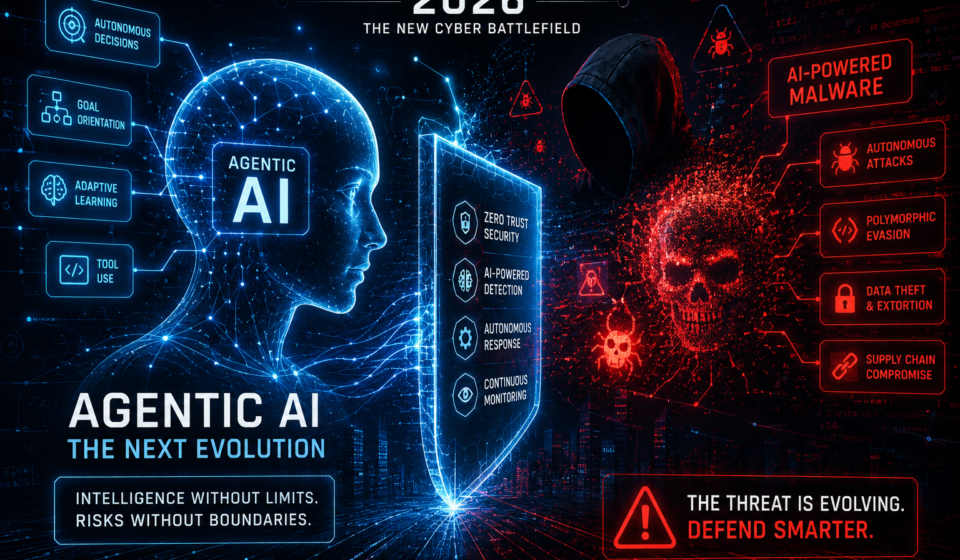
Agentic AI is fundamentally different. An AI agent is given a goal rather than a prompt. It can assemble resources, coordinate tools, make decisions, observe results, adapt its approach, and pursue that goal autonomously — without a human operator typing instructions at each step.
Think of it this way: generative AI is an excellent assistant that does brilliant work when you give it the right instructions. Agentic AI is an autonomous contractor who takes on an entire project, figures out what needs doing, and executes it — even when obstacles arise.
The critical difference for cybersecurity: Barracuda Networks (February 2026) describes it clearly: “Attackers no longer need a human operator to adjust malware or tactics when an attack is blocked. Agentic AI can respond and adapt while it is in the system, and it will continue trying until it finishes the operation or is shut down.” This isn’t a theoretical future threat. It’s happening now.
An agentic AI system used for attack typically combines: a large language model (LLM) for reasoning and content generation; a memory system for storing context across sessions; tool-use capabilities (web browsing, code execution, API calls); and a planning architecture that breaks a goal into sub-tasks and executes them sequentially. A single threat actor with access to this architecture effectively has multiple autonomous operators running attack campaigns simultaneously, 24 hours a day.
IIThe Six New Threat Vectors You Must Understand
Agentic AI hasn’t invented new categories of attack — it has turbo-charged existing ones and enabled new exploitation patterns that traditional security tools were never designed to detect. Here are the six threat vectors reshaping the landscape right now.
The 2026 distinction that matters: Traditional malware has a static payload — you find it, remove it, done. Agentic malware doesn’t stop after a failed attempt. It retries. It adapts. It escalates access through different paths. Your threat model and incident response plan must now account for autonomous retry and adaptation. Most don’t.
IIIA 25-Minute Autonomous Ransomware Attack — Step by Step
Unit 42 demonstrated this attack chain in a controlled environment in 2026. All steps executed autonomously by an AI agent, without a human operator providing instructions after the initial goal was set.
Why your current defences fail this attack: Traditional security tools detect anomalies in human behaviour patterns. An agent that executes perfectly, runs code identically 10,000 times, and mimics legitimate API traffic looks normal to signature-based detection and most SIEMs. You need behaviour-based AI detection running on the defensive side — exactly what we recommend below.
IVPrompt Injection: The Attack Your Antivirus Doesn’t See
In June 2025, a researcher sent a single crafted email to a Microsoft 365 Copilot user’s inbox. No click required. No attachment opened. No link followed. The email contained hidden instructions that Copilot ingested during a routine summarisation task. Within seconds, the agent had extracted sensitive data from OneDrive, SharePoint, and Teams — then exfiltrated it through a trusted Microsoft domain. The vulnerability earned a CVSS score of 9.3.
This is prompt injection. And according to 2026 research, indirect prompt injection now makes up over 55% of all AI agent attacks, with a 20–30% higher success rate than direct attacks due to stealth delivery through trusted sources.
The Three Most Dangerous Prompt Injection Scenarios
VHow to Protect Yourself in the Agentic AI Era
The good news: strong defences exist. The bad news: most individuals and organisations are still running 2020-era security stacks against 2026-era threats. Here is a concrete, prioritised action list for protecting yourself and your organisation right now.
-
Deploy an AI-powered antivirus with behaviour-based detectionSignature-based antivirus is blind to agentic attacks that use legitimate credentials and normal-looking API calls. You need security software that monitors behavioural anomalies — unusual data access patterns, lateral movement signatures, and abnormal process chains — not just known malware signatures. We cover the best options below. See our tested antivirus recommendations.
-
Use a VPN to encrypt all traffic and prevent ISP-level data harvestingAgentic attackers exploit open traffic to build target profiles. Encrypted connections prevent reconnaissance and protect credentials in transit. A premium VPN with a no-log policy eliminates one key reconnaissance layer. Read our complete VPN guide and our NordVPN 2026 review.
-
Use a password manager with breach monitoringInfostealers infected 11.1 million machines in 2025, generating 3.3 billion compromised credentials traded on criminal forums. Agentic attackers pair these credentials with AI testing systems to compromise thousands of endpoints simultaneously. Unique passwords for every account are now non-negotiable. See our best password managers 2026.
-
Apply the principle of least privilege to ALL AI tools you deployEvery AI agent is an identity that accumulates entitlements. A compromised agent with broad access can navigate your entire infrastructure. Restrict AI tool permissions to only what is strictly necessary for each task. Review and audit AI agent permissions quarterly — most organisations have never done this once.
-
Treat every external data source as untrusted input for AI systemsEmails, invoices, web pages, and documents processed by AI agents are all potential prompt injection vectors. Implement input sanitisation and content validation before AI systems process external data. Never let an AI agent execute actions based solely on instructions it received from unverified external sources.
-
Enable MFA on every account — especially Microsoft 365, Google, and cloud servicesAgentic credential stuffing attacks test stolen credentials against thousands of services simultaneously. Even when credentials are compromised (and with 3.3 billion in circulation, assume yours are), MFA prevents the agent from gaining access. Our password manager guide covers MFA-integrated options.
-
Install and run reputable antivirus on Android devices tooMobile devices are increasingly targeted as entry points into personal and corporate credential stores. See our best antivirus for Android 2026 guide — protecting your phone is now as important as protecting your PC.
For individuals vs organisations: Individuals need layered personal security: a reputable antivirus, a premium VPN, a password manager with breach monitoring, and MFA on every account. Organisations need all of the above plus AI-specific governance: agent identity management, zero-trust data access controls, behaviour-based SIEM with AI context, and regular AI agent permission audits. The security tools we recommend below are valid for both levels.
VIThe Security Stack That Actually Defends Against AI Threats
These are the tools we recommend to GuardedWorker readers facing the 2026 threat landscape. Each has been independently evaluated. Affiliate links are used — this is how we fund our research.
Security Stack Comparison — At a Glance
| Product | AI Threat Detection | VPN | Password Mgr | Ransomware Shield | Price/yr |
|---|---|---|---|---|---|
| Norton 360 ★ | ✓ SONAR AI | ✓ Unlimited | ✓ Included | ✓ Multi-layer | $39.99 |
| Bitdefender | ✓ Cloud AI | ✓ 200MB/day | ✓ Included | ✓ Time Machine | $29.99 |
| NordVPN | ✓ Threat Prot | ✓ Full VPN | ✗ | ✗ | $37.08 |
| 1Password | ✗ | ✗ | ✓ Watchtower | ✗ | $35.88 |
| Malwarebytes | ✓ Behaviour | ✗ | ✗ | ✓ Partial | Free/$44.99 |
The complete recommended stack: Norton 360 (primary protection + VPN + password manager) + Malwarebytes free (second-opinion scanner) + NordVPN if you need a stronger, gaming-optimised VPN. Total annual cost under $85. This covers the layered defence that the 2026 threat landscape demands. For organisations, add enterprise-grade identity management and AI governance on top.
The Reckoning Is Already Here. Are You Ready?
The agentic AI revolution in cybercrime is not a 2027 prediction. It is the active reality of April 2026. Ransomware groups like Qilin and Cl0p are deploying agentic tools to run faster, more scalable attacks. Autonomous systems are completing full attack chains in 25 minutes. Prompt injection is surging 340%. And 48% of security professionals have already identified agentic AI as the top attack vector of this year. The defences most people have are built for a previous era. The gap between what attackers can do autonomously and what defenders can detect is the most dangerous it has ever been. The tools we’ve listed above represent the minimum viable security stack for an individual or small business operating in this environment. Layered protection — antivirus, VPN, password manager — isn’t paranoia in 2026. It’s basic digital hygiene for an era in which your adversary may be running an AI system that never sleeps, never stops retrying, and has already compromised credentials from 3.3 billion machines.
VIIFrequently Asked Questions



[…] servers — servers Samsung had no Data Processing Agreement with. Samsung subsequently banned the use of generative AI tools internally, but the data had already been […]