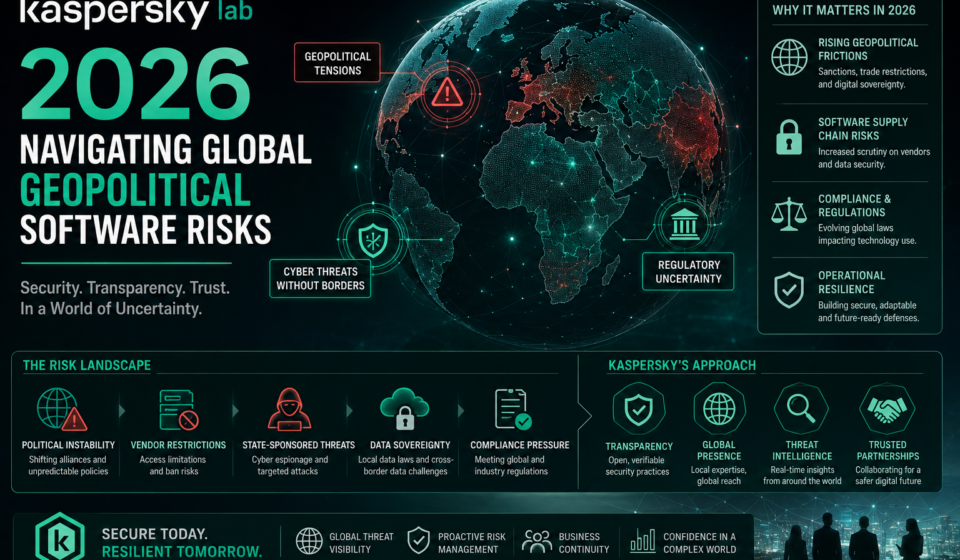

Kaspersky Lab 2026:
Navigating Global Geopolitical
Software Risks
The US ban is in effect. The UltraAV controversy continues. And 40% of US organisations are still running Kaspersky they forgot to remove. Here is the complete, balanced, and actionable picture — facts, frameworks, and the right questions to ask about every cybersecurity vendor in your stack.
- The US banned Kaspersky in June 2024, blocking new sales and updates. Roughly 40% of US orgs haven’t removed it yet as of early 2026.
- No verified, publicly confirmed evidence of intentional espionage by Kaspersky has been released — but the legal risk environment is real and documented.
- The September 2024 forced UltraAV migration without user consent triggered widespread backlash and raised additional trust concerns.
- Kaspersky’s technical performance remains top-tier — the issue is geopolitical vendor risk, not necessarily technical quality.
- For US users: switch. For EU/UK/global users: assess your sector, your data sensitivity, and your compliance obligations.
- The best alternatives are Bitdefender, Norton 360, ESET NOD32, and Malwarebytes — all with clear geopolitical risk profiles.
When Your Antivirus Becomes the Risk
Here is a scenario that would have seemed absurd in 2015: a cybersecurity company — founded to protect computers from threats — becomes itself the subject of national security concerns at the highest levels of the US government, gets banned from the country it served for decades, and then triggers fresh controversy by silently replacing its own software on users’ machines with an entirely different product. Without asking.
That is the Kaspersky Lab story in 2026 — and it is not primarily a story about whether a specific virus scanner works well. Kaspersky’s technical detection rates remain among the highest in the industry. The issue is something more structurally complex: what happens when the legal environment surrounding a software vendor creates potential risks that its technical quality alone cannot mitigate?
This guide aims to answer that question as fairly, completely, and practically as possible. We will cover what actually happened, what the evidence shows, what we don’t know, what the regulatory landscape looks like today, and — most importantly — what organisations and individuals should do with this information. If you are running Kaspersky on US infrastructure, read this today. If you are outside the US, read this as a framework for evaluating any cybersecurity vendor in a world where geopolitical software risk is a real and growing category of enterprise concern.
What Are Geopolitical Software Risks? A Clear Definition
Geopolitical software risk refers to the potential security, compliance, and operational harms that arise when a software vendor’s jurisdiction, ownership structure, or legal obligations create conflicts with a user’s national security interests, data privacy requirements, or regulatory environment. It is distinct from technical vulnerability — a product can be technically excellent while still presenting significant geopolitical vendor risk.
Traditional software risk evaluation focuses on technical factors: detection rates, false positives, performance overhead, update frequency, zero-day response. Geopolitical software risk adds an entirely different dimension: who controls the company, what legal authorities can compel that company to act, and whether those legal authorities are aligned or in conflict with your own national or organisational interests.
This framework has become increasingly important as technology increasingly crosses borders, as geopolitical tensions reshape the technology landscape, and as regulators worldwide develop new frameworks for managing software supply chain risk. The Kaspersky case is, in many ways, the world’s most extensively documented example of geopolitical software risk in action — which is exactly why studying it carefully provides so much insight for enterprise security professionals.
The Three Dimensions of Geopolitical Software Risk
The Kaspersky Geopolitical Timeline — Key Milestones
Understanding the current situation requires understanding how it developed. The Kaspersky geopolitical concern is not a 2024 development — it is the culmination of a progression that began nearly a decade ago.
Kaspersky Lab Founded
Eugene Kaspersky and colleagues found Kaspersky Lab in Moscow. Over the following two decades it grows into one of the world’s most respected cybersecurity companies, with 270,000+ corporate clients in 200 countries.
DHS Binding Operational Directive 17-01
The US Department of Homeland Security orders all federal civilian agencies to identify and remove Kaspersky-branded products from information systems. This marks the beginning of formal US government action against Kaspersky.
Congressional Ban on Federal Systems
The FY2018 National Defense Authorization Act codifies the DHS directive, making it illegal for federal contractors to use Kaspersky products. The FAR is amended to implement this prohibition.
Global Transparency Initiative Launched
Kaspersky launches its Global Transparency Initiative, including moving data processing to Switzerland, establishing Transparency Centres for code review, and inviting independent audits. The company consistently denies all espionage allegations.
FCC Adds Kaspersky to Covered List
Following Russia’s invasion of Ukraine, the FCC places Kaspersky on its Covered List, finding it poses an “unacceptable risk to national security.” Germany’s BSI issues a public warning recommending alternatives.
US Commerce Department Issues Final Determination
The Bureau of Industry and Security (BIS) bans Kaspersky from selling software or providing updates in the US, effective July 20, 2024. Simultaneously, Treasury’s OFAC sanctions 12 Kaspersky executive and leadership positions. This is the first use of the ICTS supply chain authority for a software product.
The UltraAV Controversy
Kaspersky begins automatically removing its software from US devices and replacing it with UltraAV, a product from Pango Group, without explicit user consent. Widespread user backlash follows, with reports of UltraAV reinstalling itself after removal and investigations into UltraAV’s own vendor risk profile.
The Residual Problem
Bitsight telemetry data indicates approximately 40% of US organisations that had Kaspersky installed before the June 2024 announcement still appear to have it running. The software no longer receives threat intelligence updates, creating a silent compliance and security gap.
What the Evidence Actually Shows — and Doesn’t
One of the most important things to understand about the Kaspersky case is the distinction between legal risk environment and confirmed wrongdoing. This distinction matters enormously for how we assess the situation and what conclusions we draw.
The 2017 NSA contractor incident — in which classified documents were allegedly taken from a contractor’s home computer running Kaspersky — is the most cited specific incident. However, the precise mechanism of what occurred has never been fully publicly established, and Kaspersky’s investigation suggested the files may have been inadvertently uploaded as part of threat detection analysis.
“The pattern across this timeline is the US government acting on a legal-environment risk — the Russian government’s potential authority to compel a Russian company under Russian law — rather than on a documented breach.”
— Antivirus-Review.com Research Team, April 2026What this means practically: the risk to most private individuals and non-regulated businesses is significantly lower than the risk to government agencies, defence contractors, critical infrastructure operators, and organisations handling classified or highly sensitive data. A small business owner using Kaspersky in the EU faces a very different risk profile than a US federal contractor doing so.
Enterprise Security Implications — What This Means for Organisations
For enterprise security professionals, the Kaspersky situation is a case study in cybersecurity vendor risk management — a discipline that has grown significantly in importance as software supply chain attacks have become a major threat vector.
The Silent Compliance Gap
The most immediate enterprise problem in 2026 is not actively using a banned product — it is not knowing you’re still running it. Bitsight’s telemetry data showing that approximately 40% of affected US organisations still have Kaspersky installed represents an audit and inventory failure as much as a geopolitical failure.
The risk for these organisations is nuanced: the software itself is no longer receiving threat intelligence updates, meaning it is progressively less effective against new malware. Additionally, running a product banned under ICTS regulations can have compliance implications for government contractors, publicly traded companies with SEC cybersecurity disclosure obligations, and organisations in regulated industries.
The Vendor Risk Management Framework
The Kaspersky case provides an excellent template for evaluating cybersecurity vendor risk more broadly. Security teams should ask these questions of every critical security vendor:
- 1Jurisdictional risk: In which country is the vendor headquartered? What legal obligations can the laws of that country place on the vendor? Does that country have a history of compelling tech companies to cooperate with intelligence services?
- 2Ownership transparency: Who ultimately owns the company? Are there state-owned or state-adjacent entities in the ownership chain? Have there been ownership changes that affect the risk profile?
- 3Data sovereignty: Where is user data processed and stored? Under whose legal jurisdiction? Is there an independent audit of data handling? Has the vendor moved data processing to mitigate concerns (as Kaspersky has done with Switzerland)?
- 4Code transparency: Has the vendor’s code been independently audited? Are security researchers able to review the product? Have audits found any unexpected data collection or exfiltration capabilities?
- 5Regulatory standing: What is the vendor’s status with relevant regulatory bodies? Have they been listed on government covered lists, subjected to procurement bans, or received formal national security assessments?
- 6Track record under pressure: How has the vendor behaved during geopolitical stress? The UltraAV incident — silent forced migration without user consent — is itself a trust signal worth weighing regardless of the geopolitical question.
The Global Regulatory Landscape — Country by Country
One of the most important nuances in the Kaspersky discussion is that regulatory status varies dramatically by geography. The US ban applies only in the US and creates US-specific legal obligations. Every other jurisdiction has its own rules, warnings, and decisions.
The important takeaway: the US ban is the most comprehensive formal action taken, and it is a US-specific regulatory response. European consumers and businesses are not under the same prohibition. However, organisations with US operations, US-domiciled data, or contracts with US government entities need to apply the US standard regardless of where they are headquartered.
Kaspersky’s Transparency Initiatives — What They Do and Don’t Address
It is important to give Kaspersky’s own response genuine consideration rather than dismissing it as purely defensive. The company has taken concrete, costly, and technically meaningful steps to address the concerns raised about it.
The Global Transparency Initiative (2017–Present)
Kaspersky’s Global Transparency Initiative includes several substantive measures. Their Swiss data centre, operational since 2019, moves the processing and storage of data from European, North American, and several other customer bases to Switzerland — a jurisdiction with strong privacy laws and significant political neutrality from US-Russia tensions.
Kaspersky has also established Transparency Centres in multiple locations worldwide, where government officials and qualified researchers can review source code, software updates, threat detection rules, and data-handling processes under controlled conditions. Independent cybersecurity assessments and audits have been commissioned and results published.
Kaspersky’s official statement on the US ban reads in part: “We view this decision as unjustified and baseless — influenced by geopolitical tensions rather than a thorough evaluation of Kaspersky’s products and operations. Kaspersky does not engage in activities which threaten US national security and, in fact, has made significant contributions with its reporting and protection from a variety of threat actors that targeted US interests and allies.”
This statement deserves to be taken seriously. Kaspersky has a documented history of reporting on Russian state-sponsored threat actors — it exposed APT28, Equation Group tools, and multiple other sophisticated operations that did not serve Russian state interests. This record is genuinely inconsistent with the portrait of a company fully captured by Russian intelligence.
The Best Kaspersky Alternatives in 2026 — Ranked & Reviewed
Whether you are in the US and required to migrate, or anywhere in the world and choosing to apply a precautionary approach, these are the cybersecurity products we recommend as replacements — each with a clearly documented geopolitical risk profile and strong independent lab performance. See our full Windows 11 antivirus guide and Android antivirus guide for detailed reviews of each.
Bitdefender is the most technically comparable replacement for Kaspersky — matching or exceeding Kaspersky’s detection rates in independent tests, with near-zero system performance impact, and a headquarters in Romania (EU member state, NATO alliance, no geopolitical conflict with Western security interests). Its infrastructure is subject to GDPR and independent cybersecurity audits, and it does not appear on any government covered list in any jurisdiction. For our full analysis, see our Bitdefender vs Norton comparison.
✓ Why It Replaces Kaspersky Well
- Detection rates match or exceed Kaspersky — no security compromise
- Romania HQ — EU member state, GDPR compliant, NATO alliance
- Independent security audits — transparent practices
- No government covered list appearances globally
- Autopilot mode — comparable silent operation to Kaspersky
- $29.99/yr for 5 devices — comparable or lower cost
× Limitations
- VPN limited (200MB/day) without upgrade
- Renewal price increases after Year 1
Norton 360 is the natural choice for US-based enterprises seeking maximum geopolitical clarity — it is a US-headquartered company (NortonLifeLock, now Gen Digital, Tempe Arizona), subject to US jurisdiction and US security practices. It includes dark web monitoring, 50GB cloud backup, an unlimited VPN, and class-leading parental controls. For organisations that need to demonstrate US-sourced endpoint protection for compliance purposes, Norton is the clearest option available. For more detail, read our Windows 11 antivirus guide.
ESET is headquartered in Bratislava, Slovakia — an EU member state, NATO alliance member, with no geopolitical conflicts that create security concerns comparable to Kaspersky’s Russian jurisdiction. ESET’s NOD32 is specifically notable for its extremely low system footprint, making it ideal for older hardware or users who want protection without performance impact. Security researchers often use ESET products themselves — a meaningful endorsement. For organisations on older hardware that Kaspersky was serving well, ESET is the most direct performance-profile match.
For users who need an immediate, cost-free option to assess their current exposure, Malwarebytes Free provides the best on-demand malware scanner available — use it today to check for existing threats before your full migration is complete. Malwarebytes Premium adds real-time protection at a price point ($44.99/year for 5 devices) that competes directly with Kaspersky’s pricing, with a US-based parent company and clean geopolitical risk profile. Ideal for home users and small businesses.
Complete Antivirus Comparison — Post-Kaspersky Migration 2026
| Product | HQ Jurisdiction | Geopolitical Risk | Detection Rate | Price/Year | Devices | Best For | Score |
|---|---|---|---|---|---|---|---|
| Bitdefender Total Security | Romania (EU/NATO) | Very Low | 99.9% | $29.99 | 5 | Best Overall Replace | 9.6 |
| Norton 360 Deluxe | USA (US-Domiciled) | Very Low | 99.8% | $49.99 | 5 | Enterprise/US compliance | 9.3 |
| ESET NOD32 | Slovakia (EU/NATO) | Very Low | 99.5% | $39.99 | 1 | Lightweight/privacy | 8.5 |
| Malwarebytes Premium | USA | Very Low | 99.1% | $44.99 | 5 | Budget/malware removal | 8.7 |
| Kaspersky (non-US) | Russia (via Switzerland) | Moderate-High | 99.9% | $35.99 | 3 | Tech performance only | Context-dependent |
Beyond Antivirus: Building a Geopolitically-Aware Security Stack
The Kaspersky discussion highlights a broader principle: geopolitical vendor risk applies to every software product in your security stack, not just your antivirus. A complete security hygiene audit should examine every layer.
VPN Services — Jurisdiction Matters Here Too
The same logic that makes Kaspersky’s Russian jurisdiction a concern applies to VPN services. A VPN that logs your traffic and is legally compelled to share it with its home country’s intelligence services defeats the entire point. The best VPNs for trust-conscious users are those headquartered outside 5/9/14 Eyes alliance countries, with independently audited no-logs policies. See our best VPN for remote workers guide — in particular our coverage of NordVPN (Panama HQ) and our NordVPN vs Surfshark comparison.
Password Managers — Critical Data, Clear Jurisdictions
Password managers hold your most sensitive digital credentials. Jurisdiction matters as much here as it does for antivirus. Our best password manager guide covers the top options, and our 1Password vs Dashlane comparison breaks down the two leading choices by security architecture, jurisdiction, and trust framework.
Hardware Security Keys — The Phishing-Resistant Layer
For high-value accounts, hardware security keys provide authentication that cannot be compromised regardless of what software runs on your endpoints. FIDO2/WebAuthn hardware keys (YubiKey, Google Titan) eliminate the credential-phishing risk that antivirus software cannot fully address. These are manufactured by US-based and European companies with clear, auditable supply chains.
AI, Geopolitical Software Risk, and the Future of Cybersecurity Trust
The Kaspersky case will not be the last of its kind. As AI becomes embedded in security software — running increasingly autonomous analysis, decision-making, and response capabilities — the question of whose AI is analysing your network becomes even more consequential than the question of whose antivirus scans your files.
The same jurisdictional risk logic applies: an AI-powered security platform that sends telemetry data to servers in a country with compelled-disclosure laws presents the same category of risk as Kaspersky does — potentially amplified by the richness of the data AI systems collect. Enterprise security teams should build geopolitical vendor risk assessment into their evaluation criteria for all AI-powered security tools, not just traditional antivirus.
“The question is no longer just ‘is this software technically safe?’ The question is: ‘under whose legal authority does the company that built this software ultimately operate?'”
— GuardedWorker Security Research TeamSeveral emerging frameworks are helping organisations structure this evaluation:
NIST Cybersecurity Framework (CSF) 2.0
NIST’s updated framework explicitly addresses supply chain and vendor risk management, providing a structured approach to evaluating third-party software providers that incorporates both technical and governance-level risk factors.
EU Cybersecurity Act and ENISA Guidelines
European organisations should familiarise themselves with ENISA’s guidance on geopolitical software risk, which provides a framework for public-sector and critical-infrastructure entities that is directly applicable to the Kaspersky type of situation.
Software Bill of Materials (SBOM)
The emerging requirement for software vendors to provide a complete inventory of components, including their origins and jurisdictions, is one of the most promising developments in geopolitical software risk management. An SBOM requirement for enterprise security software would make the kind of analysis we’ve applied to Kaspersky standardised and systematic.
Frequently Asked Questions
The Measured Verdict: What You Should Do
The Kaspersky Lab situation in 2026 is genuinely complex — and that complexity deserves to be respected rather than collapsed into a simple “it’s Russian, delete it” narrative or an equally simplistic “no proven espionage, keep using it” dismissal.
Here is the measured, factual verdict:
If you are in the United States: The decision has been made for you by law. Kaspersky is effectively banned, no longer receives updates, and running it creates both compliance and security risks. Migrate to Bitdefender, Norton 360, ESET, or Malwarebytes today. Run an endpoint audit to verify you’ve found every installation.
If you are in the EU or most other jurisdictions, as a consumer: The legal risk is lower and the practical risk for typical personal data is modest. The decision comes down to your comfort with the geopolitical context and your assessment of Kaspersky’s transparency measures. Alternatives like Bitdefender offer comparable technical performance with a significantly clearer risk profile — and switching costs are minimal.
If you are an enterprise, especially in a regulated industry, handling sensitive data, or with any US operations or obligations: The vendor risk framework answers this clearly. A security vendor whose home country’s legal system creates theoretical compelled-cooperation risk should not be part of your critical security infrastructure, regardless of its technical quality. The Kaspersky situation is the clearest possible lesson in why geopolitical vendor risk must be a standing element of your security evaluation criteria.
Finally: the broader lesson extends well beyond Kaspersky. As geopolitical tensions reshape the technology landscape, and as AI makes security software increasingly powerful and data-rich, the question of whose software you trust will only grow in importance. Build the evaluation framework now. Apply it systematically. And keep reading — the cybersecurity threat landscape evolves faster than any single article can track.
Complete Your
Geopolitically-Aware
Security Stack
Antivirus + VPN + Password Manager = full-layer protection with clear vendor accountability
Affiliate disclosure: GuardedWorker earns a commission on qualifying purchases at no extra cost to you. Our editorial positions are independent of commercial relationships.
Further Reading from GuardedWorker
Build your complete, geopolitically-aware security understanding with these companion guides: