
Home › Blog › VPN Reviews › PIA Review 2026
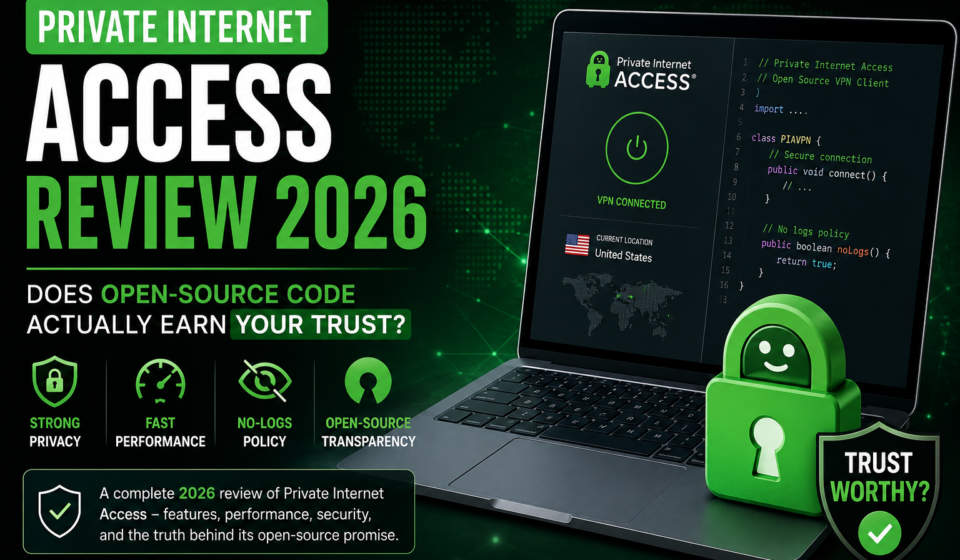
Private Internet Access (PIA) Review 2026: Is Open-Source Transparency Enough to Trust It?
PIA is one of the few VPNs whose no-logs policy has been proven in a federal court — not just audited. But does open-source code, court cases, and a Deloitte audit outweigh its US jurisdiction? We ran the full test so you don’t have to.
Private Internet Access (PIA) has been doing something for over a decade that most VPNs only claim to do: it publishes its source code on GitHub — all of it, for every platform. Windows, macOS, Linux, Android, iOS. Anyone, from security researchers to curious developers, can read every line and confirm there’s no hidden backdoor, no covert data collection, no silent telemetry.
That’s a bold claim in an industry where most “privacy” labels are marketing. So in this review, we dig into what PIA’s open-source commitment actually means for you, how its court-proven no-logs policy stacks up against competitors, where PIA genuinely excels — and where it falls short of the very best VPNs on the market in 2026.
✓ What We Love
- Fully open-source apps on all platforms — inspect the code yourself
- No-logs policy proven in US federal court three times
- Deloitte audit confirmed zero data retention (2022)
- Unlimited simultaneous device connections
- Advanced customisation: WireGuard, OpenVPN, split tunnelling, port forwarding
- MACE ad & tracker blocker built-in
- RAM-only servers across all 50 US states
- Cheapest long-term pricing among premium VPNs (~$2/month)
- Accepts anonymous cryptocurrency payments
- 30-day money-back guarantee
✗ Where It Falls Short
- Headquartered in the US — a 5-Eyes intelligence-sharing country
- Inconsistent in China and heavily censored regions
- Streaming unblocking is hit-or-miss without dedicated IP
- Live chat support quality varies significantly
- Interface can overwhelm non-technical users
- Virtual servers make up over 50% of locations
- No post-quantum encryption support yet
- Removed granular cryptographic customisation in latest version
1. What “Open Source” Actually Means for Your Privacy
The term “open source” gets thrown around constantly in the VPN industry, often as a vague badge of trust. PIA is one of the very few top-tier VPNs that has made every single client app publicly available on GitHub — Windows, macOS, Linux, Android, and iOS. That’s not selective transparency. That’s the whole stack.
Why does this matter? Because when software is closed-source, you’re trusting a company’s promise. When it’s open-source, you’re trusting verified, peer-reviewed code. Security researchers worldwide can — and do — independently audit it for backdoors, privacy leaks, or sloppy coding. PIA’s bug bounty programme (launched 2022) pays researchers who find and responsibly disclose vulnerabilities, creating a continuous community-driven security feedback loop.
This is a meaningful differentiator. As we explored in our deep dive on how agentic AI is changing the threat landscape, attackers increasingly target VPN infrastructure itself. Open-source code reduces the attack surface on the client side — something closed-source providers simply cannot offer.
The Bug Bounty Programme
PIA’s Whitehat Security Alert programme incentivises external security researchers to report vulnerabilities via formal Vulnerability Disclosure forms. This model is common in enterprise software but rare in consumer VPNs. It means PIA’s codebase benefits from more eyeballs than any internal security team alone could provide.
2. PIA’s No-Logs Policy: Court-Proven, Not Just Audited
Anyone can write a privacy policy promising not to keep logs. The difference with PIA is that its no-logs claim has been tested in actual US federal courts — multiple times — and survived each time.
“When US law enforcement demanded user data, PIA had nothing to hand over. The logs simply did not exist. That’s not a marketing claim — it’s a legal record.” — GuardedWorker Analysis, 2026
Beyond court cases, PIA commissioned a formal third-party audit from Deloitte — a Big Four accounting firm — in June 2022. The audit confirmed that PIA’s technical configuration matched its stated privacy policy, and that no identifiable logs or user activity data was stored. PIA’s RAM-only server architecture is central to this: since all data lives in volatile memory, it’s permanently deleted every time a server reboots.
What About US Jurisdiction?
PIA is based in Denver, Colorado — firmly within the United States, a founding member of the Five Eyes intelligence alliance. This is legitimately concerning in theory. The US can issue National Security Letters (NSLs) with gag orders, compelling companies to hand over data silently.
In practice, PIA’s architecture neutralises this risk: if the data doesn’t exist, it cannot be handed over. Court documents already confirm this. However, if absolute jurisdictional peace of mind is your priority, consider a provider based in Switzerland or the British Virgin Islands. Our NordVPN vs Surfshark comparison covers providers in those jurisdictions in detail.
PIA also releases regular transparency reports publicly disclosing all government requests received and data provided (consistently: zero user data). This is the gold standard of corporate accountability for a VPN provider.
3. Security Architecture: Encryption, Protocols & MACE
Encryption Standards
PIA supports AES-256-bit encryption — the same standard used by military and government systems. One unique feature is user-selectable encryption strength: under OpenVPN, you can choose between AES-128 (faster) and AES-256 (stronger). Most VPNs don’t give you this option. For WireGuard, encryption is locked to ChaCha20, which is both highly efficient and secure.
Note: as of 2026, PIA removed the most granular cryptographic customisations (manual handshake and hash selection) to resolve compatibility issues. OpenVPN now enforces RSA-4096 handshakes with SHA-2 authentication as standard — which is actually the right architectural call. Removing weak options prevents users from accidentally degrading their own security.
OpenVPN TCP/UDP — Battle-tested, most configurable, AES-128/256 selectable.
IKEv2/IPSec — Available on iOS only, excellent for mobile network switching.
MACE: PIA’s Built-In Ad & Malware Blocker
MACE is PIA’s DNS-level blocking system for ads, trackers, and known malware domains. It operates at the DNS layer — meaning it blocks requests before they reach your browser — rather than as a browser extension. This makes it more lightweight than browser-based blockers and harder to circumvent.
Important caveat: MACE doesn’t block all paid ads (it focuses on tracking domains and malware), and it’s less feature-rich than dedicated tools. If you’re experiencing targeted phishing or AI-powered social engineering attacks (an increasingly serious threat — see our AI Phishing Protection Tools 2026 guide), a dedicated security layer on top of PIA is still wise.
Leak Protection
PIA runs its own private DNS servers, eliminating third-party DNS exposure. In 10+ independent leak tests, PIA showed zero IP, DNS, or WebRTC leaks across all server locations. This is a non-negotiable baseline for any trustworthy VPN, and PIA clears it convincingly.
The kill switch — available on Windows, macOS, iOS, and Linux — cuts your internet connection instantly if the VPN tunnel drops, preventing accidental exposure. On Android, PIA deliberately relies on the OS-level “Always-on VPN” setting instead, which provides superior system-level protection.
4. Speed Tests: Real-World Performance in 2026
PIA operates a NextGen server network with 10 Gbps network cards across its infrastructure — hardware that most budget VPNs simply don’t have. The real-world speed impact depends heavily on your base connection and the server you choose.
For users connecting to nearby servers, PIA is consistently one of the fastest VPNs tested. A 25% speed loss on a 500 Mbps connection is barely perceptible for streaming, gaming, or downloading. Long-distance connections (say, a UK user connecting to Singapore) show steeper drops — but this is true of every VPN and is a function of physics, not PIA’s architecture.
5. Streaming & Unblocking: Where PIA Shines (and Doesn’t)
PIA supports over 20 streaming platforms including Netflix US, UK, Japan, Germany, and Italy, Amazon Prime Video, Disney+, and BBC iPlayer — using dedicated streaming-optimised servers. At 10 Gbps, there’s no bandwidth bottleneck on PIA’s end.
PIA’s obfuscation via Shadowsocks (available on Windows, macOS, Android, Linux) works well for hiding VPN usage from ISPs and navigating moderately restrictive networks. For heavily censored countries like China or Iran, PIA is not reliable. If you need a VPN specifically for those regions, PIA is the wrong tool.
6. Pricing: Unbeatable Value or Too Good to Be True?
PIA’s long-term pricing is genuinely exceptional. At around $2/month on a 2-3 year plan, it’s the most affordable premium VPN on the market — and unlike many budget providers, the quality of privacy protection is not compromised to hit that price point.
All plans include unlimited simultaneous connections — PIA removed all device limits. A single subscription covers your entire household. This alone makes PIA exceptional value for families or users with many devices.
Payment Options (Including Anonymity)
PIA accepts credit cards, PayPal, and — importantly — cryptocurrency via BitPay (15+ cryptocurrencies supported). Pair a crypto payment with a burner email address and you have a completely anonymous account with zero financial paper trail linking you to your VPN usage. This is the gold standard of privacy-preserving sign-up.
7. PIA vs NordVPN vs ExpressVPN: The Honest Comparison
No VPN review is complete without direct comparison. Here’s how PIA stacks up against the two most popular alternatives — for a more detailed breakdown, see our full NordVPN vs Surfshark comparison.
| Feature | PIA | NordVPN | ExpressVPN |
|---|---|---|---|
| Open-Source Apps | ✓ All platforms | △ Partial | △ Partial |
| Court-Proven No Logs | ✓ 3× US courts | ✗ Not tested | ✗ Not tested |
| Audit (Big 4) | ✓ Deloitte 2022 | ✓ PricewaterhouseCoopers | ✓ KPMG |
| Jurisdiction | 🇺🇸 US (5-Eyes) | 🇵🇦 Panama | 🇧🇻 BVI |
| WireGuard | ✓ | ✓ (NordLynx) | ✗ (Lightway only) |
| Simultaneous Devices | ✓ Unlimited | △ 10 | △ 8 |
| Port Forwarding | ✓ | ✗ | ✗ |
| Streaming (consistency) | △ Good | ✓ Excellent | ✓ Excellent |
| Price (long-term/mo) | ✓ ~$2 | △ ~$3.99 | ✗ ~$6.67 |
| China Reliable | ✗ No | △ Sometimes | ✓ Yes |
PIA is the only major VPN where its no-logs policy has been stress-tested in a courtroom — not by choice, but because authorities tried to get data that simply wasn’t there.
8. Who Should Buy PIA in 2026?
PIA is the Right Choice If…
- You want verifiable, open-source transparency — not just a privacy policy
- You torrent and need port forwarding + unlimited P2P on all servers
- You’re a power user who wants to configure protocols and encryption yourself
- You want to connect unlimited devices on one subscription
- Budget is a consideration — PIA is the best-value premium VPN available
- You’re protecting against public Wi-Fi attacks or ISP surveillance
- You want to pay anonymously with cryptocurrency
- You’re a Linux user who needs a full GUI application
Consider an Alternative If…
- You’re in China, Iran, or another heavily censored country — PIA is unreliable there
- Streaming is your primary use case and you want guaranteed access to every library
- You need VPN servers physically located in your country (over 50% of PIA’s network is virtual)
- US jurisdiction is a hard dealbreaker for your threat model
- You’re a non-technical user who wants the simplest possible app
Top Alternative VPNs to Consider
NordVPN
Panama jurisdiction, NordLynx protocol, unbeatable streaming reliability. The #1 overall VPN in most 2026 rankings. Slightly pricier than PIA but worth it for streaming.
From ~$3.99/month
Read Review Get Deal →ExpressVPN
The fastest VPN in 2026 thanks to its proprietary Lightway protocol. Best for China, gaming, and users who need maximum speed without compromise.
From ~$6.67/month
Read Review Get Deal →Surfshark
Great value with unlimited devices, strong streaming, and Netherlands jurisdiction. Our NordVPN vs Surfshark comparison breaks down which one wins for your use case.
From ~$2.49/month
See Comparison Get Deal →Protect All Your Devices — Not Just Your VPN
A VPN encrypts your traffic, but it doesn’t protect against malware, phishing, or credential theft on your endpoints. If you’re serious about digital security, pair PIA with a strong antivirus. Our Best Antivirus for Windows 11 2026 guide covers the top picks, and if you’re on Android, see our Best Antivirus for Android roundup.
For complete account protection, add a password manager to your stack. See our Best Password Manager 2026 guide — or the detailed 1Password vs Dashlane 2026 head-to-head.
Private Internet Access: Exceptional Transparency, Excellent Value, One Caveat
PIA delivers something genuinely rare in the VPN market: verifiable privacy. Open-source code you can audit yourself. A no-logs policy that has withstood federal court pressure — not once, but three times. A Deloitte-audited technical infrastructure that physically cannot retain your data. For the price, no competitor comes close.
The caveat is real but manageable. US jurisdiction is a theoretical risk that PIA’s architecture and track record have consistently neutralised. If you need to bypass censorship in China or Iran, look elsewhere. If streaming reliability is your #1 priority, NordVPN or ExpressVPN are safer bets.
But for privacy-first power users, torrenters, remote workers, and anyone who wants to verify what their VPN is actually doing — PIA is our recommendation. Try it risk-free for 30 days →
FAQ: Private Internet Access in 2026
More From GuardedWorker
Ready to Try PIA Risk-Free?
30-day money-back guarantee. Unlimited devices. Court-proven no logs. Open-source code.
The most transparent premium VPN you can buy — for ~$2/month.