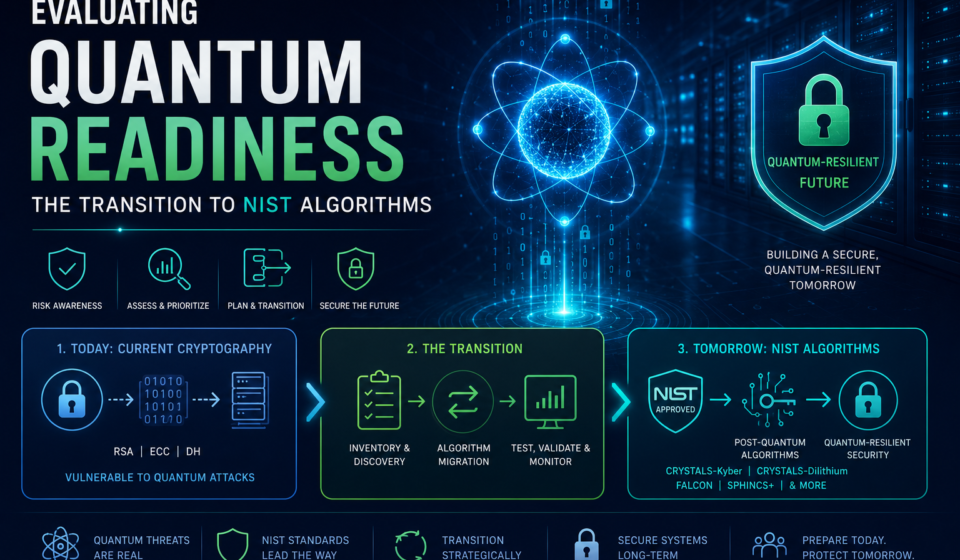

Evaluating Quantum Readiness: The Transition to NIST Algorithms
NIST finalized its post-quantum cryptography standards in August 2024. The countdown to Q-Day has started — and most organizations are dangerously behind. Here’s everything you need to know, and every tool that can protect you now.
2026 Year of Quantum Security
The Encryption Wall
Is About to Break.
Are You Ready?
📋 Table of Contents
- The Quantum Problem No One Wants to Talk About
- What Is Quantum Readiness (And Why It Matters Now)
- The NIST Post-Quantum Algorithms Explained
- The “Harvest Now, Decrypt Later” Threat Is Real Today
- The Migration Timeline: Deadlines You Must Know
- Who Is Most at Risk? Sector-by-Sector Breakdown
- Best Tools & Products for Quantum-Safe Security (2026)
- Best Quantum-Ready VPNs Compared
- How to Perform a Quantum Readiness Assessment (Step-by-Step)
- Frequently Asked Questions
1. The Quantum Problem No One Wants to Talk About
Imagine spending a decade building a vault with the strongest lock money can buy — and then being told that within a few years, anyone with the right machine can open it in seconds. That is precisely the situation facing every organization relying on classical encryption today.
Quantum computers are not science fiction. They are operational, increasingly powerful, and — according to major tech firms including Google and IonQ — are approaching a threshold that will render RSA-2048, ECC, and Diffie-Hellman mathematically trivial to break. The cybersecurity landscape of 2026 is already defined by this looming inflection point.
The Cloud Security Alliance estimates that a cryptographically relevant quantum computer (CRQC) capable of breaking RSA-2048 could arrive as early as 2030. IonQ has published a roadmap targeting CRQC capabilities by 2028. The window to act is narrow.
The problem is not hypothetical. Nation-state actors are already running “harvest now, decrypt later” operations — intercepting and storing encrypted communications today, waiting for quantum hardware to mature before decrypting everything in bulk. Classified government files. Sensitive healthcare records. Financial transaction histories. Banking credentials. All of it, sitting in foreign data warehouses, clocks ticking.
The Federal Reserve’s 2025 research paper confirmed that HNLD (Harvest Now, Decrypt Later) represents a present-day risk — not a future one. Data encrypted today with vulnerable algorithms may be readable in 5–10 years.
2. What Is Quantum Readiness — And Why It Matters Right Now
Quantum readiness is an organization’s measurable capability to detect, plan for, and successfully migrate all cryptographic systems from classical algorithms to post-quantum cryptography (PQC) before cryptographically relevant quantum computers become operational.
It is not merely an IT upgrade. It is a full audit of every cryptographic dependency across your entire stack — from TLS handshakes on your website to certificate authorities, hardware security modules (HSMs), key management systems, cloud providers, IoT devices, legacy applications, and even embedded firmware.
“2026 is the Year of Quantum Security, marking a move from research to operational deployment. Where 2025 focused on awareness, 2026 is about action.”
— AppViewX PQC Readiness Report, 2026
Most organizations genuinely do not know where all their encryption lives. According to research from the Cloud Security Alliance, the majority of enterprises have not yet completed a cryptographic inventory. Encryption exists in places they have never audited: forgotten APIs, third-party SDK dependencies, build pipelines, mobile apps, SaaS subscriptions, and cloud-provider-managed keys.
This is the first barrier to quantum readiness — and addressing it cannot wait until production deadlines are breathing down your neck.
Boston Consulting Group’s 2025 assessment stated directly that starting migration in 2030 will already be too late, given the asset-by-asset, certificate-by-certificate, protocol-by-protocol enumeration that any credible enterprise migration requires.
3. The NIST Post-Quantum Algorithms Explained
On August 13, 2024, NIST published the first finalized post-quantum cryptography standards — the culmination of an eight-year global competition that began in 2016 and reviewed 82 initial algorithm submissions. Here are the three finalized standards you need to know:
Module-Lattice-Based Key Encapsulation Mechanism. The primary standard for general encryption — how two parties securely exchange secret keys over an unsecured channel.
NIST highlights its comparatively small key sizes and exceptional operational speed, making it practical for real-world deployment across TLS, HTTPS, and VPN protocols.
Key Exchange TLS/HTTPS VPNs Primary StandardModule-Lattice-Based Digital Signature Algorithm. The primary standard for digital signatures — verifying that data, code, and communications have not been tampered with.
Replaces ECDSA and RSA-based signatures. Expected to be used in 99.9% of post-quantum signature scenarios, covering software signing, certificates, and authentication.
Digital Signatures Code Signing Authentication Primary StandardStateless Hash-Based Digital Signature Algorithm. A backup signature algorithm based on hash functions rather than lattices — providing algorithmic diversity and a fallback if ML-DSA is ever found vulnerable.
Slower and larger than ML-DSA but offers independent mathematical security assumptions as a critical safety net.
Digital Signatures Backup Standard Hash-Based DiversityWhat About the Algorithms Still in Development?
NIST is not done. FN-DSA (FIPS 206) — based on the FALCON algorithm — is a lattice-based digital signature algorithm that produces smaller signatures, making it valuable for constrained environments. It was in draft form during 2024–2025 and expected to be finalized in 2025–2026. Additionally, in March 2025, NIST selected HQC (Hamming Quasi-Cyclic) as an additional backup key encapsulation mechanism, providing a non-lattice alternative to ML-KEM for algorithmic diversity.
AES-256 and SHA-2/SHA-3 are considered quantum-resistant and do NOT require replacement for post-quantum purposes. Organizations should focus migration efforts on public-key cryptography (RSA, ECC, DH, ECDSA, etc.), not symmetric encryption.
4. The “Harvest Now, Decrypt Later” Threat Is Real — Today
This is the aspect of quantum risk that keeps chief information security officers awake at night, and it is happening right now.
The attack is simple in concept: An adversary — most likely a nation-state with long-range intelligence objectives — systematically intercepts and records encrypted data in transit today. The data is meaningless now, locked inside RSA-2048 or ECC encryption that would take classical computers thousands of years to crack. But in 5–10 years, once a cryptographically relevant quantum computer exists, that adversary decrypts everything instantly.
Who would do this? Intelligence agencies already operating under decades-long data retention mandates. Adversaries targeting critical infrastructure, pharmaceutical patents, financial systems, government communications, and legal records. The data being harvested right now potentially includes:
- Classified government and military communications
- Long-term contract negotiations, M&A activity, and financial strategies
- Medical research, drug trial data, and patient records
- Law firm communications and attorney-client privileged files
- Cryptocurrency wallet seed phrases transmitted digitally
- Critical infrastructure operational data and control protocols
This is why the transition to post-quantum cryptography must begin now — not when quantum computers arrive. By then, it will be too late for data already harvested.
5. The Migration Timeline: Deadlines You Must Know
The regulatory picture is now clear, and the deadlines are binding — not guidelines. Here is the complete timeline organizations must plan against:
6. Who Is Most at Risk? Sector-by-Sector Breakdown
Not all sectors face equal urgency. Here is a frank assessment of which industries face the most severe exposure:
🏦 Financial Services — Extreme Risk
Banks, payment processors, and trading platforms rely entirely on public-key cryptography for transaction authentication, inter-bank communication, and digital signatures. A broken RSA key means fraudulent transactions are indistinguishable from legitimate ones. Migration complexity is high due to legacy core banking systems that cannot be patched easily.
🏥 Healthcare — Critical Risk
Electronic health records (EHR), HIPAA-protected communications, pharmaceutical intellectual property, and medical device communications are all exposed. Healthcare data has a uniquely long sensitivity window — a patient record harvested today could still be deeply sensitive in 2040. Critically, many medical devices run embedded firmware with hardcoded cryptographic parameters and have 10–20 year lifespans.
🏛️ Government & Defense — Immediate Action Required
Federal agencies are already under NSA and NIST mandates. Classified communications networks, weapons systems authentication, and diplomatic channels are primary targets of nation-state harvest operations.
💻 Technology & SaaS — High Risk
Cloud providers, SaaS platforms, and technology companies sit at the top of the supply chain — their cryptographic choices determine the security of every downstream customer. Companies like Cloudflare have already begun deploying ML-KEM in production.
🏭 Critical Infrastructure — Severe, Overlooked Risk
Power grids, water treatment, and industrial control systems are especially vulnerable because their cryptographic implementations are embedded in hardware with decade-long replacement cycles. Many operators genuinely do not know what algorithms their SCADA systems use.
7. Best Tools & Products for Quantum-Safe Security (2026)
The security industry has moved fast to respond to NIST’s finalized standards. Here are the most important product categories and specific tools available today — including our affiliate recommendations with honest assessments.
🔒 Quantum-Ready VPNs
A VPN (Virtual Private Network) is your front line of defense for encrypting internet traffic. The best providers have already begun integrating post-quantum key agreement into their tunneling protocols.
NordVPN Editor’s Choice
NordVPN has already deployed post-quantum encryption using ML-KEM in its NordLynx protocol — one of the first commercial VPNs to move from theory to live deployment. It combines the speed of WireGuard with quantum-safe key exchange, protecting your traffic against both today’s threats and tomorrow’s quantum attacks.
Why we recommend it: Best combination of quantum-resistant encryption, speed, and user-friendliness. Read our full NordVPN Review 2026 for a deep-dive.
Get NordVPN — Best Deal →ExpressVPN
ExpressVPN is actively integrating post-quantum cryptography into its Lightway protocol. It remains one of the fastest VPNs available and has historically led the industry in protocol innovation. Best choice for users prioritizing speed with a premium quantum migration roadmap.
See our detailed ExpressVPN Review 2026.
Try ExpressVPN →Surfshark
Surfshark offers unlimited simultaneous connections — making it exceptional for families and businesses with many devices. Its development team has publicly committed to post-quantum encryption integration as part of its 2026 roadmap.
Compare in our NordVPN vs Surfshark 2026 comparison.
Get Surfshark →🛡️ Quantum-Aware Antivirus & Endpoint Protection
While antivirus software does not perform key exchange directly, the best 2026 platforms have integrated identity-layer and certificate validation that is beginning to support PQC certificate chains. Read our Best Antivirus for Windows 11 in 2026 and our Bitdefender vs Norton 2026 deep-dive.
Bitdefender Total Security
Consistently ranked #1 for threat detection. Bitdefender is actively updating its certificate validation and identity-layer security to support PQC standards. Strong for comprehensive endpoint protection alongside a quantum-ready VPN.
Try Bitdefender →Norton 360 with LifeLock
Norton’s identity theft protection features make it especially relevant for post-quantum threats — since a broken public key could expose identity credentials. Norton 360 bundles a built-in VPN, dark web monitoring, and cloud backup.
Get Norton 360 →🔑 Quantum-Ready Password Managers
Password managers use encryption to secure your vault. As PQC standards roll out, the best providers will need to update their vault encryption schemes. Start with a provider that has a clear quantum migration roadmap.
1Password
1Password has one of the most transparent security architectures in the password manager space, with a dedicated security team that has already published documentation on its post-quantum cryptography migration roadmap. Best option for security-conscious individuals and enterprise teams.
See our comparison: 1Password vs Dashlane 2026.
Start with 1Password →8. Best Quantum-Ready VPNs Compared (2026)
To help you make an informed decision, here is a direct comparison of the leading VPNs and their current quantum cryptography support status:
| VPN Provider | PQC Status | Algorithm Used | Protocol | Servers | Price/Mo | Best For |
|---|---|---|---|---|---|---|
| NordVPN ⭐ | ✓ Live Now | ML-KEM | NordLynx | 6,400+ | ~$3.49 | All-around best |
| ExpressVPN | ⚠ In Progress | PQC Roadmap | Lightway | 3,000+ | ~$6.67 | Speed focus |
| Surfshark | ⚠ 2026 Roadmap | Planned ML-KEM | WireGuard | 3,200+ | ~$2.49 | Unlimited devices |
| Mullvad VPN | ✓ In Beta | ML-KEM hybrid | WireGuard+ | 700+ | $5.00 | Privacy purists |
| ProtonVPN | ⚠ Testing | PQC Testing | WireGuard | 9,000+ | ~$4.99 | Open source users |
*Pricing reflects promotional rates available at time of publication. Check current deals at each provider. ⚠ = actively developing PQC support. ✓ = deployed in production.
9. How to Perform a Quantum Readiness Assessment (Step-by-Step)
Whether you are an IT manager at a mid-size company or a security architect at an enterprise, here is a practical framework for evaluating your quantum readiness today.
Step 1: Build Your Cryptographic Inventory (CBOM)
A Cryptographic Bill of Materials (CBOM) is the foundation of any quantum migration. You cannot migrate what you cannot see. Map every cryptographic dependency: TLS certificates, code signing certificates, API authentication keys, SSH keys, database encryption keys, HSMs, VPN configurations, and third-party SaaS tools.
Consider using automated cryptographic discovery tools such as IBM’s Crypto Discovery, Cryptosense Analyzer, or emerging PQC migration platforms like QSE’s QPA v2 (launched March 2026) which provides AI-enhanced assessment and real-time executive dashboards.
Step 2: Classify Risk by Data Sensitivity and Longevity
Not all encrypted data carries equal risk. Prioritize data that must remain confidential for more than 5 years — because this data is already in the HNLD window. Create a risk matrix: High risk = long-lived sensitive data (health records, classified files, financial contracts). Medium risk = operational data. Low risk = transient session data.
Step 3: Identify Cryptographically Agile vs. Hardcoded Systems
Cryptographic agility means a system can change its encryption algorithm without a complete rebuild. Many enterprise applications have hardcoded RSA or ECC and require significant engineering to migrate. Identify these early — they represent your longest migration lead times.
Step 4: Deploy Hybrid Cryptography Immediately
While full PQC migration takes time, you can start protecting traffic immediately through hybrid deployments — combining classical algorithms with post-quantum ones. For example: ML-KEM + X25519 for key exchange. This means traffic is protected even if one algorithm is eventually compromised. This is the recommended transitional approach from NIST and the IETF.
Step 5: Update VPN and Perimeter Security First
Your VPN is your most exposed public-key cryptography surface — all internet-facing traffic passes through it. Switching to a quantum-ready VPN like NordVPN is the single highest-impact, lowest-effort action most organizations can take today. Do it first.
Step 6: Build a Migration Roadmap with Executive Buy-in
PQC migration is a board-level strategic issue. According to the Cloud Security Alliance, organizations that treat it as an IT project rather than an enterprise risk initiative consistently underestimate scope, budget, and timeline. The 2035 NIST deadline may feel distant — but BCG’s analysis shows migration takes years of discovery, testing, and coordination.
Step 7: Monitor Ongoing Standards Development
The PQC standards landscape is still evolving. FN-DSA (FIPS 206) is being finalized. HQC was added in March 2025. Stay subscribed to NIST’s CSRC announcements and ensure your security team has a process for evaluating new standards as they emerge.
🛡 Quick-Start Action Plan
- Today: Switch to a quantum-ready VPN (NordVPN with ML-KEM is live now)
- This week: Start a cryptographic inventory — list every system using RSA, ECC, or DH
- This month: Classify data by sensitivity lifespan — identify HNLD exposure
- Q3 2026: Begin deploying hybrid TLS (ML-KEM + X25519) on perimeter systems
- 2027: Full migration of certificates, code signing, and authentication systems
- 2030: All legacy applications migrated per NSA CNSA 2.0 requirements
10. Frequently Asked Questions
Switch to a quantum-ready VPN. NordVPN already deploys ML-KEM in production, meaning your internet traffic is protected against harvest-now-decrypt-later attacks right now. Plans start at $3.49/month with a 30-day money-back guarantee.
Get NordVPN With Quantum Protection →