
The Danger of Shadow AI Governance Gaps in Corporate Networks
Employees across your organization are using unauthorized AI tools right now — feeding company data to ChatGPT, Gemini, and dozens of others without IT knowing. Here’s what that silence is costing you, and exactly how to stop it.
Imagine your CFO pastes a confidential merger agreement into ChatGPT to get a quick summary. Your HR director asks an AI chatbot to rewrite a list of employees flagged for performance review. Your dev team pushes proprietary source code into Copilot for a “quick fix.” None of them told IT. None of them asked Legal. And your company just violated GDPR, breached attorney-client privilege, and exposed trade secrets — before lunchtime.
This is not a hypothetical. This is Shadow AI — and it’s happening inside your corporate network every single day in 2026.
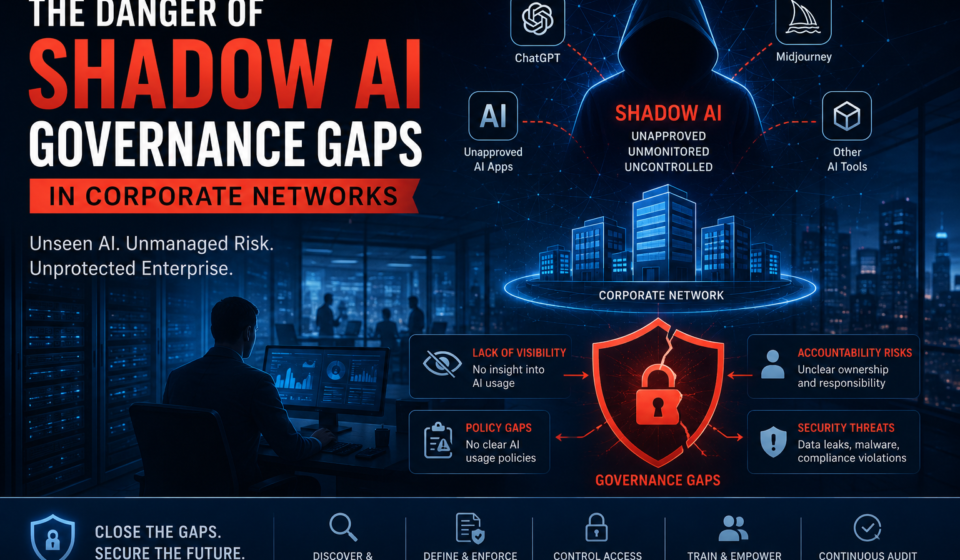
The term “shadow IT” has existed for decades, but the rise of powerful, accessible AI tools has created a new and far more dangerous variant. Unlike shadow IT of the past (think: employees using personal Dropbox to share files), Shadow AI involves tools that actively process, analyze, retain, and sometimes train on sensitive corporate data — often with no visibility, no oversight, and no off-switch.
Shadow AI doesn’t just mean employees breaking policy. It means your most sensitive intellectual property, customer records, financial data, and legal communications are potentially being stored, processed, and used to train third-party AI models — with no legal agreement in place to protect you.
In this guide, we’ll break down exactly what Shadow AI is, where the governance gaps are, what the consequences look like, and — crucially — what tools and strategies your organization can deploy right now to close those gaps before a breach or regulator does it for you.
What you need to know about Shadow AI governance gaps
- Shadow AI is the use of unauthorized AI tools by employees without IT or Legal approval
- The risks include data exfiltration, compliance violations (GDPR, HIPAA, SOC2), and IP theft
- Most organizations have zero visibility into which AI tools employees are using daily
- Effective governance requires policy, technical controls, employee education, and the right tools
- Products like NordVPN Teams, 1Password Business, and Bitdefender GravityZone can form part of your defense layer
What Is Shadow AI? (And Why It’s Worse Than Shadow IT)
Shadow IT refers to any hardware, software, or cloud service used inside an organization without the explicit knowledge or approval of the IT department. For years, the biggest examples were consumer file-sharing apps like Dropbox or Google Drive, personal email accounts, or unofficial project management tools like Trello or Slack.
Shadow AI is a dramatically more dangerous evolution. The defining characteristic of modern AI tools is that they don’t just store data — they process it, generate outputs from it, and in many cases, use that data to improve future model performance. When an employee pastes a client contract into an AI assistant, that text doesn’t simply sit in a database. It becomes an input to a system whose data handling practices, retention policies, and training use may be entirely opaque to your organization.
The Scale of the Problem in 2026
Recent industry surveys paint a stark picture. According to research from IBM’s 2026 Cost of a Data Breach Report, the average breach now costs $4.9 million — and AI-related data leakage events are among the fastest-growing incident categories. Meanwhile, a Salesforce State of AI report found that over 83% of employees admit using AI tools not approved by their employer. That number has nearly doubled since 2024.
The problem isn’t malicious intent. Most employees using Shadow AI are simply trying to do their jobs faster. The governance gap exists not because of bad actors, but because AI adoption has outpaced policy-making at virtually every organization on the planet.
“The speed at which generative AI tools proliferated in 2024 and 2025 meant that most enterprise security teams were still writing the policy while employees were already three tools deep.”
— Enterprise Security Analyst, Gartner Research 2026
The Five Most Dangerous Shadow AI Governance Gaps
Not all governance gaps are equal. Some create regulatory exposure. Others create direct IP theft risk. Here are the five most critical gaps organizations face today:
🔴 Critical — Data Exfiltration via Prompts
Employees submitting sensitive data — customer records, financial models, source code, legal documents — directly to external AI APIs. This data may be retained, analyzed, or used for training by the AI provider.
🔴 Critical — Zero Visibility & Auditability
IT has no log of which AI tools are being used, what data was submitted, or what outputs were generated. In the event of a breach or regulator inquiry, this creates catastrophic audit trail failures.
🟠 High — Compliance Violations (GDPR, HIPAA, SOC2)
Personal data of EU customers submitted to a US-based AI tool immediately raises GDPR lawful basis and transfer mechanism questions. Healthcare data submitted to any unvetted AI tool may violate HIPAA.
🟠 High — IP & Trade Secret Leakage
Proprietary algorithms, pricing strategies, M&A plans, and product roadmaps submitted to AI tools become potential training data — giving AI providers (and potentially competitors) insight into your most sensitive assets.
🟡 Medium — AI-Generated Misinformation at Scale
Employees using unvetted AI tools may distribute AI-generated outputs — incorrect financial data, legal summaries, or customer-facing content — without human review, creating liability and reputational risk.
🟡 Medium — Vendor Lock-In & Shadow Spend
Ungoverned AI subscriptions — often paid on personal cards or expensed without proper vendor review — create untracked financial exposure and relationships with unevaluated third-party vendors.
Real-World Consequences: What Happens When Shadow AI Goes Wrong
These aren’t theoretical risks. The past 18 months have produced a series of high-profile incidents directly tied to ungoverned AI use in corporate environments:
The Samsung Source Code Incident
In one of the most widely cited examples, Samsung engineers submitted proprietary semiconductor manufacturing code and internal meeting notes to ChatGPT for assistance. The data was processed by OpenAI’s servers — servers Samsung had no Data Processing Agreement with. Samsung subsequently banned the use of generative AI tools internally, but the data had already been transmitted.
GDPR Enforcement Actions
Italy’s data protection authority temporarily banned ChatGPT in 2023 over GDPR concerns, and regulators across the EU have since issued enforcement guidance making clear that submitting personal data to any AI tool without an appropriate legal basis and Data Processing Agreement is a potential violation. For companies processing EU resident data, this creates enormous exposure.
Legal Privilege Breaches
Law firms and in-house legal teams have submitted privileged communications to AI summarization tools — potentially waiving attorney-client privilege by disclosing to third parties. The legal consequences of this are still being tested in courts worldwide.
Companies actively searching for “AI governance software,” “enterprise AI security tools,” or “how to monitor employee AI use” are typically within 30–90 days of a major incident or audit — or they’ve just had their first executive conversation about this risk. If that’s your organization, the tools below can help immediately.
Tools to Close Your Shadow AI Governance Gaps Right Now
Governance isn’t just policy — it’s technology. The right combination of tools gives you visibility, control, and audit capability. Here are the solutions most relevant to organizations tackling Shadow AI risk in 2026:
NordVPN Teams / NordLayer Best for SMBs
NordLayer (formerly NordVPN Teams) gives IT admins the ability to route corporate traffic through a controlled gateway, enabling visibility into which AI endpoints employees are connecting to. You can block access to unapproved AI tools at the network level, enforce split tunneling policies, and maintain audit logs — all without deploying complex enterprise firewall infrastructure. Reviewed in-depth by our team: NordVPN Review 2026.
Get NordLayer — Block Shadow AI Read Full ReviewBitdefender GravityZone Business Security Top Rated 2026
Endpoint Data Loss Prevention (DLP) is your last line of defense when network controls fail. Bitdefender GravityZone includes content-aware DLP that can detect and block attempts to upload sensitive file types, keywords, or data patterns to external web destinations — including AI tools. It provides real-time alerting, tamper-proof audit logs, and integrates with SIEM platforms. See our Bitdefender vs Norton 2026 comparison for a full breakdown.
Try Bitdefender GravityZone Free See Comparison1Password Business Most Popular
One overlooked Shadow AI attack vector is credential sharing: employees creating personal accounts on AI platforms with corporate email addresses. 1Password Business solves this by giving IT full visibility into every SaaS login in the organization — including AI tools. You can see which AI platforms have corporate credentials, enforce strong passwords and MFA, and instantly revoke access to unauthorized tools. Read our 1Password vs Dashlane 2026 head-to-head.
Start 1Password Business Trial See Best Password Managers 2026ExpressVPN for Business Free Trial
For remote and hybrid workers — where Shadow AI risk is highest because oversight is lowest — ensuring all traffic routes through a corporate-controlled VPN is essential. ExpressVPN’s Lightway protocol delivers sub-100ms latency even for AI-heavy workloads, while providing the traffic visibility your security team needs. See our ExpressVPN 2026 Review and our guide to the Best VPN for Remote Working in 2026.
Try ExpressVPN — 30 Day Free Read Full ReviewShadow AI Governance Tool Comparison at a Glance
| Tool | AI App Blocking | Audit Logs | DLP | Best For | Free Trial |
|---|---|---|---|---|---|
| NordLayer | ✓ Yes | ✓ Yes | ✗ No | Network control for SMBs | 14 days |
| Bitdefender GravityZone | ✓ Yes | ✓ Yes | ✓ Yes | Enterprise endpoint DLP | 30 days |
| 1Password Business | ✗ No | ✓ Yes | ✗ No | Credential & access control | 14 days |
| ExpressVPN Business | ✓ Via policy | ✓ Yes | ✗ No | Secure remote worker access | 30 days |
| Avast Business Hub | ✓ Yes | ✓ Yes | ✓ Partial | SMB all-in-one protection | 30 days |
How to Build a Shadow AI Governance Framework: A Step-by-Step Guide
Technology tools alone won’t solve the problem. You need a governance framework that combines policy, technology, and culture. Here’s how to build one in 2026:
Conduct an AI Tool Audit
Before you can govern Shadow AI, you need to know what’s being used. Deploy network traffic analysis or endpoint agents to identify all external AI endpoints your organization is currently communicating with. This includes obvious tools (ChatGPT, Claude, Gemini, Copilot) and less-visible ones (AI features embedded in SaaS tools like Notion, Salesforce, HubSpot, and dozens more). Our guide to AI Privacy Tools in 2026 covers tools that can help with this discovery process.
Classify Your Data and Define Risk Tiers
Not all data carries equal risk. Establish a data classification policy that categorizes information by sensitivity: Public, Internal, Confidential, and Restricted. Then define explicitly which categories (if any) may be submitted to AI tools, under what conditions, and with which approved platforms only. Legal, HR, Finance, and IP data should typically be Restricted from all external AI use without explicit approval.
Create and Communicate an AI Acceptable Use Policy
Write a clear, practical AI Acceptable Use Policy (AUP). It should cover: which AI tools are approved; what data may and may not be submitted; consequences for violations; and how employees can request approval for new AI tools. The policy should be written in plain English — not legal jargon — and distributed company-wide with mandatory acknowledgment. Related: How Agentic AI Is Changing the Malware Landscape.
Deploy Technical Controls
Policy without enforcement is just a document. Implement technical controls: network-level blocking of unapproved AI domains (via NordLayer or equivalent), endpoint DLP to detect sensitive data patterns in browser uploads (Bitdefender GravityZone), and credential management to audit which AI platforms hold corporate credentials (1Password Business). For remote workers, ensure all traffic routes via a corporate VPN (ExpressVPN or NordLayer).
Establish an AI Vendor Vetting Process
Create a lightweight but rigorous process for evaluating and approving new AI tools. Key criteria: Does the vendor have a BAA (Business Associate Agreement) or DPA (Data Processing Agreement)? Does the tool offer a “no training” data mode? What are the data retention policies? Is the vendor SOC2 Type II certified? This process should take days, not months — or employees will route around it.
Train Employees — Continuously
The majority of Shadow AI use is accidental, not malicious. Employees don’t realize the risk. Conduct security awareness training specifically covering AI data risks — not as a one-time event, but as regular, role-specific briefings. High-risk roles (Legal, Finance, HR, Engineering) should receive deeper training on what data they handle and why AI tools create specific risks for their function. See our guide on AI Phishing Protection Tools 2026.
Monitor, Audit, and Iterate
The AI tool landscape changes monthly. New AI features are quietly added to existing SaaS tools. New models emerge. Employees discover new ways to use tools you haven’t yet assessed. Build a monthly review cadence where your security team reassesses approved AI tools, reviews incident reports, and updates the AUP. Use SIEM integration from your endpoint solution to flag anomalous data upload patterns automatically.
The Compliance Dimension: GDPR, HIPAA, and Beyond
For regulated industries, Shadow AI isn’t just a security problem — it’s a direct compliance and legal liability. Let’s examine the major regulatory frameworks and how Shadow AI governance gaps intersect with each:
GDPR (EU General Data Protection Regulation)
GDPR requires that personal data of EU residents only be processed by third parties under a valid Data Processing Agreement (DPA), with an appropriate legal basis, and — for data transferred outside the EU — under an approved transfer mechanism like Standard Contractual Clauses (SCCs). When an employee submits EU customer data to an AI tool without an approved DPA in place, your organization may be in direct violation of Articles 28 and 44–49 of GDPR. Fines can reach €20 million or 4% of global annual turnover — whichever is higher.
HIPAA (Health Insurance Portability and Accountability Act)
Any Protected Health Information (PHI) submitted to an AI tool that is not a HIPAA Business Associate triggers a potential breach. HIPAA requires a Business Associate Agreement (BAA) with any third party that handles PHI. Very few consumer AI tools offer BAAs. If your employees are in healthcare or work with healthcare data, a single prompt containing patient information can constitute a reportable breach.
SOC 2 Type II
If your organization is pursuing or maintaining SOC 2 compliance, evidence of ungoverned AI tool use — and the absence of controls to prevent it — will directly impact your audit findings in the Security, Availability, and Confidentiality trust service criteria. Auditors are increasingly asking about AI governance controls specifically.
Understanding the evolving cyber threat landscape is critical context for AI governance. Read our deep-dive on How Agentic AI Is Changing the Malware Landscape in 2026 and our investigation into The VENOM Phishing Kit Targeting Executives.
Shadow AI and the Insider Threat Connection
Governance gaps don’t just create accidental risk — they create deliberate exploitation opportunities. When employees know that their AI tool usage isn’t monitored, it removes a critical deterrent for insider threat actors.
Consider the scenarios: a disgruntled employee exfiltrates a customer database by submitting it to an external AI tool for “processing,” knowing there’s no DLP to catch them. A competitive intelligence actor uses approved AI tools to systematically extract and summarize internal strategy documents. A bad actor uses AI-generated phishing content — crafted using stolen internal communications submitted to an AI — to target your executives.
The connection between Shadow AI governance gaps and insider threat risk is direct and underappreciated. Our analysis of how executives are being targeted by the VENOM phishing kit shows how AI-enabled social engineering is becoming increasingly personalized using data that often originates from corporate networks.
The single highest-impact action you can take today: deploy a password manager with SaaS visibility (like 1Password Business) and audit which AI platforms hold credentials tied to corporate email addresses. This takes under 4 hours and immediately shows you your full Shadow AI footprint.
What “Good” AI Governance Looks Like in 2026
Organizations getting AI governance right share several characteristics. They’ve moved beyond the reactive “ban everything” approach (which simply drives Shadow AI further underground) to a structured, permissive-with-guardrails model:
An Approved AI Tool Registry
Rather than an undifferentiated block list, leading organizations maintain a living registry of approved AI tools, their permitted use cases, data categories they may process, and the contractual protections in place. This registry is updated monthly and accessible to all employees — so they know exactly which tools they can use without asking.
A Self-Service AI Request Process
When employees want to use a new AI tool not yet on the registry, they can submit a request through a lightweight intake form. Security and Legal review it against a standard rubric and respond within five business days. This removes the main driver of Shadow AI: employees choosing unofficial tools because the official approval process is too slow.
Technical Parity Between Security and Productivity
The best AI governance programs invest as much in enabling legitimate AI productivity as they do in blocking unauthorized use. By ensuring employees have access to capable, approved AI tools — and are trained to use them effectively — you reduce the temptation to go rogue. Related: our list of the Best Free AI Tools 2026.
Avast Business Hub 2026 Updated
For small and medium businesses that need a single-pane-of-glass security solution, Avast Business Hub combines antivirus, firewall, web content filtering (including AI site categories), device management, and basic DLP. It’s significantly more affordable than enterprise alternatives and can be deployed across an entire SMB in under a day. Full breakdown in our Avast Antivirus 2026: Free vs Premium review.
Try Avast Business — 30 Days Free Read ReviewFrequently Asked Questions About Shadow AI Governance
Related Articles from GuardedWorker
Deepen your cybersecurity knowledge with these hand-picked reads from our editorial team:
The Bottom Line: Act Before the Breach Does It for You
Shadow AI governance gaps are not a future risk. They are a present, active, and expanding liability inside your organization right now. Every day that your employees use unauthorized AI tools without oversight is a day that sensitive data is flowing outside your security perimeter — to servers, models, and companies you have no relationship with and no control over.
The good news: this is a solvable problem. Unlike many cybersecurity threats that require sophisticated attacker TTPs to exploit, Shadow AI governance gaps exist primarily because of a policy vacuum — one that can be filled with clear rules, the right tools, and genuine employee education.
Start with visibility. Know what AI tools are being used in your network. Then build a policy that enables legitimate AI productivity while protecting sensitive data. Then layer in the technical controls — VPN, DLP, password management — to enforce that policy. And iterate continuously, because this landscape will not stand still.
The organizations that get AI governance right in 2026 will have a meaningful competitive and security advantage. The ones that don’t will be reading about themselves in breach disclosure reports.
This week: Audit your DNS/web proxy logs for AI tool domains. This month: Draft and publish an AI Acceptable Use Policy. This quarter: Deploy endpoint DLP and network-level AI access controls. The first step costs nothing — the consequence of skipping it might cost everything.